
.svg)
Why Your Google Ads Scale Breaks After $X Per Day


There's a pattern that shows up across accounts of all sizes. Campaigns run profitably at $300/day. Someone decides to double the budget. Within a week, ROAS collapses, CPA spikes, and the account looks completely different from what it was before. The assumption is that Google Ads broke. Usually, the account hit a ceiling and nobody recognised it before pushing through it.
There is no universal Google Ads spend ceiling – that’s also why you see the “X” in this article’s headline. But almost every account eventually hits a point where simply adding budget stops producing the same return. The question isn't whether this will happen. It's which type of ceiling you've hit – because each one requires a different fix.
Is It Normal for ROAS to Fall as Google Ads Scale?
Yes. ROAS compression at scale is one of the most predictable patterns in paid media. It doesn't mean the account is broken. It means you've started reaching audiences that are further from a buying decision, and every incremental dollar of spend is doing slightly harder work than the one before it.
When we scaled one of our clients – a DTC supplement brand – from $69K to $200K per month in Google Ads spend, almost entirely through prospecting, blended ROAS dropped from 1.43x to 1.11x. That compression was expected and intentional. The account remained profitable at every stage. The question we asked at each budget increase wasn't “why is ROAS going down?” – it always will at scale – but “is it still above the profitability threshold?” What's not normal is ROAS dropping immediately after a budget increase and never recovering. That points to a structural failure.
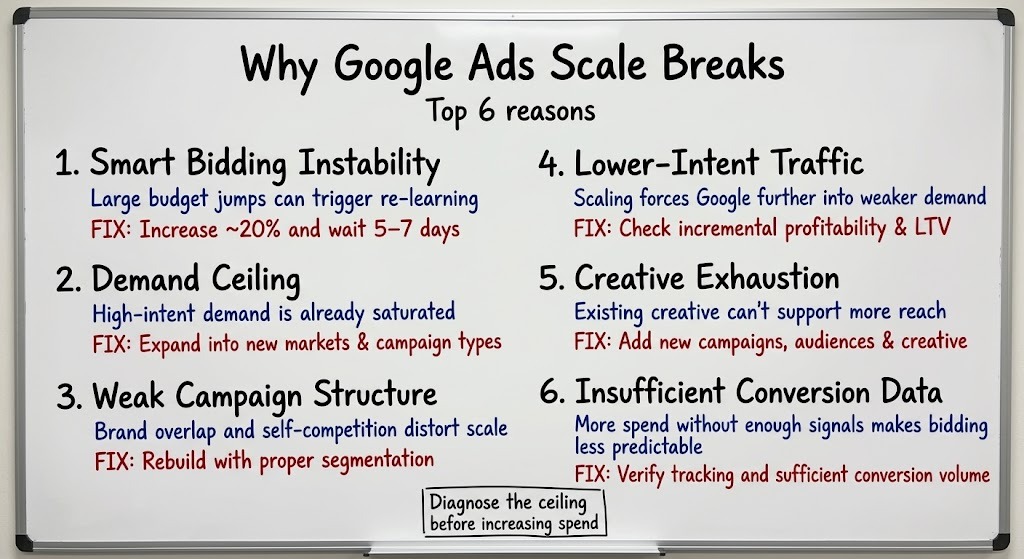
Top 6 Reasons Your Google Ads Scale Breaks
Reason 1: Budget Increases Can Destabilise Smart Bidding
A significant budget increase can give Smart Bidding a new optimisation problem to solve. It has to find additional auctions, test a broader traffic pool, and recalibrate its predictions. As a practical scaling rule, we typically increase budgets by around 20% at a time and leave 5–7 days between changes. Larger jumps can destabilise performance, especially when the campaign is already close to the limits of its existing conversion volume.
The most common mistake is reacting to the initial performance drop by making even more changes. That can make it impossible to tell whether you're seeing a temporary adjustment or a genuine structural problem. Give the campaign enough time to stabilise – often 1–2 conversion cycles or 1 to 3 weeks – before deciding that the strategy itself has stopped working.
“The most expensive diagnostic mistake is treating a re-learning dip as a structural failure. Leave the account alone for 1–3 weeks after a significant budget increase before concluding that the strategy isn't working.”
Reason 2: You've Hit the Demand or Impression Share Ceiling
Search and Shopping have a finite pool of high-intent demand. Once you've captured a large share of the available searches in your market, there simply aren't enough additional high-quality auctions to absorb more budget at the same efficiency. In one account we’ve managed, the impression share exceeded 70% across most prospecting campaigns. At that point, pushing more budget into the same campaigns raised CPCs without producing proportional gains in conversion volume.
The response to this type of ceiling isn't to keep increasing bids or forcing more spend through saturated campaigns. It's to expand horizontally: into new markets, campaign types, keyword clusters, or other sources of demand. When you've captured most of the available demand in one pool, the next dollar needs a new pool to work in.
Reason 3: Your Campaign Structure Wasn't Built for the New Budget
Structural problems that are invisible at $200/day can become major constraints at $500/day or $1,000/day. One of the most common problems is brand contamination: when branded searches bleed into prospecting campaigns, ROAS looks artificially strong because branded traffic converts more efficiently. As you scale prospecting spend, that inflated baseline disappears and the account suddenly looks much less efficient.
Self-competition creates another problem – this is particularly common in accounts running both Shopping and Performance Max. Multiple campaigns bidding on overlapping queries can push CPCs up while splitting data across campaigns. Catch-all structures can have a similar effect: when one campaign contains too many products or very different economics, Google's algorithm tends to concentrate spend on whichever products or traffic convert most easily. You end up with an account that scales one product while the rest stagnates. The fix here isn't incremental optimisation. It's rebuilding the architecture with proper segmentation before scaling spend further.
Reason 4: You're Buying Lower-Intent Traffic
At lower spend levels, Google can concentrate budget on the strongest available conversion opportunities. As you scale, that pool gets progressively smaller relative to your budget requirements. The algorithm has to reach further to spend the available budget: users with weaker signals, longer decision cycles, and lower purchase probability. You're still buying traffic in your category, but the quality distribution of that traffic has shifted. The result is usually gradual ROAS compression or rising CPA rather than an immediate collapse.
The relevant question here is whether the incremental customers being acquired at that compressed ROAS are still profitable, and whether they carry LTV that the platform-level ROAS data doesn't capture. Brands with strong repeat-purchase dynamics or high LTV can often push spend further into this territory than their first-purchase ROAS suggests, because these customers may generate additional revenue through repeat purchases that isn't reflected in the initial acquisition ROAS.
Reason 5: Your Creative Inventory Can't Support the Spend
Creative can become the ceiling before budget does, particularly on YouTube and Demand Gen. As spend increases, the same creative is shown to the available audience more frequently. Frequency rises, CTR can fall, and eventually Google may struggle to spend additional budget because the existing creative doesn't provide enough fresh reach.
We saw this directly while scaling a YouTube campaign. The campaign had reached around $5K/day, but when we pushed further, Google couldn't spend the additional budget because the campaign had exhausted the reach available to its existing creative. The solution was horizontal expansion: new campaigns, audiences, placements, and creative, which eventually helped the account reach $150K/month. At meaningful spend levels, you need a creative pipeline, not one winning ad that worked six months ago.
Reason 6: Your Conversion Data Can't Support the Scale
Smart Bidding is only as good as the conversion signals it receives. As a practical benchmark, Target CPA bidding can be introduced after around 20 to 30 conversions per month, while Target ROAS is typically introduced after around 30 to 50 conversions per month. The right volume depends on the campaign, conversion cycle, and bid strategy. If the budget grows much faster than conversion volume, the algorithm has to make more bidding decisions without a proportional increase in useful signals. Performance becomes less predictable, and scaling becomes harder to control.
Data accuracy matters just as much as volume. A tracking error that looks relatively minor at $300/day can become a major problem at $3,000/day because Smart Bidding is optimising towards the wrong outcome at a much larger scale. Before scaling budget significantly, verify that your conversion tracking is accurate and that conversion volume will scale proportionally with the increased spend. Everything else built on top of bad data will be wrong.
How to Diagnose Which Ceiling You've Actually Hit
The six reasons above produce different symptoms. Treating the wrong ceiling wastes time and often makes the situation worse. Before making any changes, identify what you're actually looking at.
The most important diagnostic principle is to change one variable at a time. Accounts that simultaneously adjust bidding, restructure campaigns, and launch new creative in response to a scaling problem rarely identify the real cause – because too many things change at once, and performance becomes impossible to attribute.
Breaking Through the Ceiling: What Actually Works
The right lever depends on which ceiling you've hit. But there are five approaches that consistently unlock growth past a stall point:
- Horizontal scaling is the most reliable path past a demand ceiling. Rather than pushing more budget into saturated campaigns, expand the surface area: new geographic markets, new campaign types (Demand Gen, YouTube), new keyword clusters, or additional landing pages targeting different stages of intent. Each new campaign finds its own audience pool and operates independently.
- Structural rebuild is the answer when architecture is the constraint: clean brand/prospecting separation, dedicated campaigns or asset groups for major product categories, and bidding targets that give the algorithm cleaner signals. An account that can't tell you precisely where its conversions are coming from at the campaign level isn't ready to scale further.
- A dedicated creative pipeline solves creative exhaustion, but only if creative production is treated as an ongoing operational function rather than a one-time launch task. At meaningful spend levels, new creative concepts should enter rotation consistently, underperformers should be retired early, and proven winners should be scaled systematically.
- Feed and product expansion is particularly powerful for Shopping and Performance Max: product duplication with differentiated titles, lifestyle imagery versus catalogue photography, and custom labels for performance-based bidding can expand the reach of an existing catalogue without requiring new SKUs. The feed is often one of the highest-leverage scaling inputs eCommerce brands overlook.
- New audience signals and markets apply when existing campaigns have exhausted their current audiences. Competitor URLs, in-market segments, customer match lists, and lookalike signals give the algorithm new starting points for prospecting, while international expansion – properly structured with country-level campaign segmentation – opens entirely new demand pools.
None of these are quick fixes. Horizontal scaling takes time to stabilise, structural rebuilds carry short-term risk, and creative pipelines require consistent investment. The brands that scale sustainably treat these as ongoing operational requirements, not emergency responses to a stall.
The Bottom Line: Spend Ceiling vs. Strategy Ceiling
Most accounts eventually hit a point where increasing the budget stops producing the same return. At that stage, the next step isn't simply to spend more, but to identify what's limiting further growth, whether that's campaign structure, creative, conversion data, or available demand.
Throwing more budget at the same setup is the fastest way to destroy a profitable account. The key is diagnosing which ceiling you've actually hit before increasing spend further. Once you identify the right lever – whether that's horizontal expansion, a structural rebuild, a creative refresh, or a tracking fix – scaling beyond a certain spend level becomes much more manageable.

Ready To Start Scaling Today?
Scaling Your Favorite eCommerce Brands To The Highest Levels Through Google & YouTube Ads.

.svg)
Get Smarter About How To Scale Your Brand...
Discover Insider Knowledge On How We Scale Brands From 7 Figures All The Way Up To 8-9 Figures With Google Ads.
.svg)
.svg)
"The best Google ads agency there is. You only need to look at the quality of clients and the reviews to understand Jackson and his team are the real deal."

"One of the best in the agency space, great service and exceptional results. Since signing on with Jackson he has become one of our greatest assets when scaling."

"Top tier team & service delivery. Jackson is relentless when it comes to fulfilment & client needs. His attention to detail during the onboarding process ensured exponential results for my coaching business. If you're looking to elevate your ad results & learn a tone of new options/skills that can be implemented to drive more sales to your business then I'd strongly recommend Echelonn."

"From the very first conversation with Jackson and his team, it was clear that we had found a Google Ads agency that prioritises results above all else. Their collaboration between data-driven experts and a skilled copywriter creates a dynamic duo for Google advertising success..."

"Been working with them for 9 months and it's been a great experience. Jackson and his team know what they are doing and always goes above and beyond. If you're looking for a reliable Google ads agency this is the one."

"The best Google ads agency there is. You only need to look at the quality of clients and the reviews to understand Jackson and his team are the real deal."
"One of the best in the agency space, great service and exceptional results. Since signing on with Jackson he has become one of our greatest assets when scaling."
"Top tier team & service delivery. Jackson is relentless when it comes to fulfilment & client needs. His attention to detail during the onboarding process ensured exponential results for my coaching business. If you're looking to elevate your ad results & learn a tone of new options/skills that can be implemented to drive more sales to your business then I'd strongly recommend Echelonn."
"From the very first conversation with Jackson and his team, it was clear that we had found a Google Ads agency that prioritises results above all else. Their collaboration between data-driven experts and a skilled copywriter creates a dynamic duo for Google advertising success..."
"Been working with them for 9 months and it's been a great experience. Jackson and his team know what they are doing and always goes above and beyond. If you're looking for a reliable Google ads agency this is the one."
More Articles Like This.
Find answers to common queries about our services and how we can help you.
.svg)
Performance Max Audience Signals Explained
Google Ads Optimization Score: Should You Trust It?
What Is a Good CTR for Google Ads?
Why More Google Ads Spend Doesn't Always Mean More Revenue

How To Rank Your Google Shopping Ads Multiple Times
Why Your Google Ads Scale Breaks After $X Per Day
How to Tell if Your Google Ads Agency Is Underperforming
Why Your Performance Max Campaign Gets Clicks but No Sales
.png)
Why Your Google Ads Budget Isn't Spending (And How to Fix It)

The Right Way to Run Google Dynamic Search Ads
How to Get New Customers With Google Ads in 2026
Why Your Google Ads CPA Keeps Increasing and How to Reduce It
What Is a Good ROAS for eCommerce Businesses?
How to Set Up Google Ads Conversion Tracking the Right Way
How Much Does a Google Ads Agency Cost?
Why Your Google Ads Are Not Converting
.png)
Average CPC in Google Ads by Industry (And What It Means for Your Strategy)
Performance Max vs. Shopping Campaigns: Which One is Better?

Why Your Google Shopping Ads Get Impressions But No Clicks (Image Optimization Guide)
Why Your Google Ads Are Not Showing

YouTube Ads Targeting Framework That's Driven $10M+ for eCommerce Brands

What Professional Google Shopping Ads Management Looks Like
How Much Do Google Ads Cost in 2026?

Should Your Business Use Google Search Ads or Performance Max?

Performance Max Best Practices for Sustainable Growth
.png)
Google Shopping Ads Audience Targeting: What Actually Impacts Performance
.png)
How to Write Google Search Ads That Actually Convert
.png)
6 Google Shopping Feed Best Practices That Drive Better ROAS
%20(1).png)
How to Get Your Products Recommended by AI (ChatGPT, Google AI & More)
.png)
Common Google Ads Myths That Cost Businesses Money
.png)
7 Benefits of Google Shopping Ads for Your eCommerce Business
.png)
How to Switch Google Ads Agency Without Losing Performance or Data
.png)
Demand Capture vs Demand Generation: Where Google Ads Fits
.png)
How to Prepare Your Business for Working With a Google Ads Agency

How to Avoid Wasting Budget on the Wrong Searches With Google Ads Keyword Match Types
Google Ads Account Ownership: What Businesses Should Know Before Hiring an Agency
.png)
Landing Page Optimization Strategies That Increase Conversions
SEO and Google Ads: How Search Engine Optimization and Paid Search Work Together
Types of Remarketing in Google Ads: How Each One Works and When to Use It
Google Ads Keyword Research: How to Find Keywords That Actually Convert
.png)
What Is Google Performance Max and How Does It Work?
.png)
How Advertorials Support High-Intent Google Ads Funnels
%20(Canva%20Template).png)
How Audience Targeting Works in Google Search Ads (and When to Use It)

Google Ads for New Brands: What to Know Before Spending Your First Dollar
.png)
What Is a PPC Agency – and When It Makes Sense to Hire One
.png)
How to Improve Your Google Ads Conversion Rate

.png)
The Right Way to Link Shopify and Google Ads for Scalable Growth
Google Shopping Campaigns Setup Guide 2025
Confessions of a Google Ads Auditor: The Worst Mistakes We See Inside eCom Accounts

How to Spy on Competitor Google Ads: Complete 2025 Guide
%20(2).png)
7 Questions to Ask Before Hiring a Google Ads Consultant
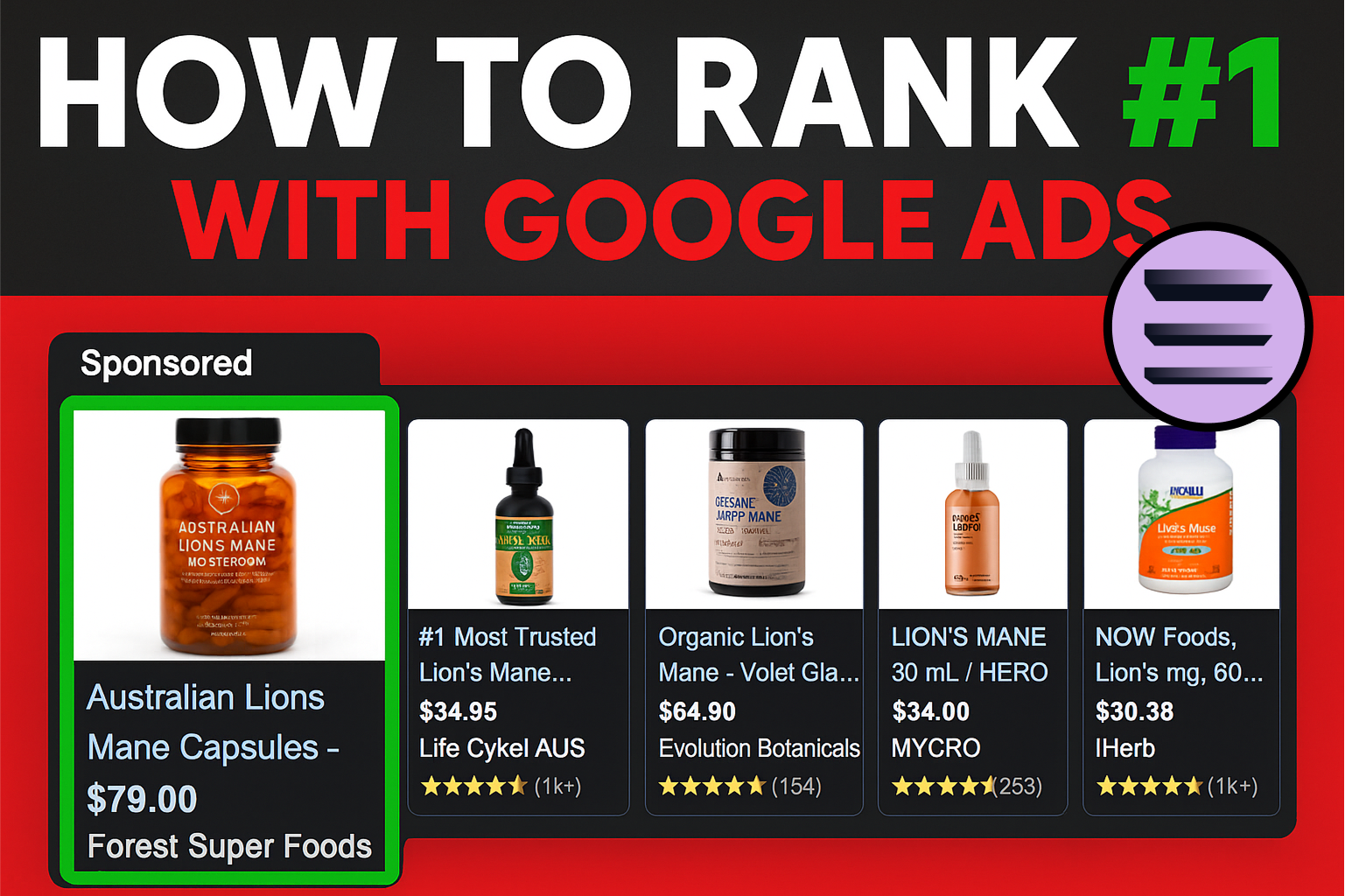
How to Rank #1 on Google Ads: Complete Shopping & Search Guide 2025
.png)
Learning Google Ads in 2025: The Roadmap Nobody Talks About
%20(1).png)
What Makes a Google Ads Specialist Worth $10,000/Month?

Why Cheap Google Ads Consulting Costs You $180,000+ in Lost Revenue
.png)
Why 99% of Google Ads Experts Fail (& How to Find One That Won’t)
.png)
5 Google Product Feed Fixes for eCom Growth
.png)
Google Ads Campaign Structure: Why 95% of Brands Waste Budget on Mixed Traffic

In-House vs Agency Google Ads: Which Delivers Better ROI in 2025?
.png)
How to Scale Google Ads With a Small Budget | Setup and Optimization

Google Shopping Optimization: 11 Proven Tactics for Maximum ROAS
%20(3).png)
eCom Growth Strategy: How We Scaled a Supplement Brand From $1.9M to $8.6M With Google Ads
%20(4).png)
Google Merchant Center Fix: How to Improve Rankings With Accurate Shipping Times

CTR Is Misunderstood by 95% of the PPC Industry (What to Optimise for Instead)
.png)
Google Ads AI | Manual vs Automated Campaign Performance

Complete YouTube Ads Guide 2025 | 3 Formats, 5 Principles, Proven Results
%20(2).png)
eCom Growth Strategy With Google Ads in 2025
.png)
Google Marketing Live 2025: 11 Key Takeaways for Marketers
%20(1).png)
YouTube Advertising Strategy: How to Drive Results Across Every Format
Google Shopping Feed Optimisation: Tips for Better Results

How Long Does it Take for Google Ads to Work?

YouTube Ads Analytics 101: Key Metrics and How to Use Them

Search Ad Strategies to Maximize Sales with Google ads for eCommerce (2024)

2025 Google Shopping Ads: Ultimate Guide, Benchmarks, and Pricing Breakdown

Maximizing ROI with Advanced Google Shopping Bid Strategies and Automated Bidding