
.svg)
Landing Page Optimization Strategies That Increase Conversions


.png)
Landing page optimization is often framed as a design decision – colors, button shapes, form length, layout structure. While these elements matter, conversion depends on more than visual tweaks alone.
For most performance-driven businesses, landing page optimization is shaped by traffic intent, offer clarity, and acquisition strategy. When those elements are misaligned, even well-designed pages struggle to convert. But when they work together, adjustments can produce measurable impact. This article explores the strategies behind effective landing page optimization, clarifies the role landing pages play in Google Ads performance, and outlines how optimization differs between eCommerce and lead generation models.
Why Landing Page Optimization Is a Strategic Lever, Not Just a Design Decision
A landing page should reflect:
- the traffic you generate (brand vs non-brand, generic vs product-specific)
- the stage of the decision journey
- the clarity of your value proposition
- the strength of your data signals
Within Google Ads accounts, for example, landing page performance directly influences Quality Score and shapes how Smart Bidding interprets conversion signals. If those signals are inconsistent or weak, automated systems tend to optimize around patterns they can measure most reliably. That doesn’t always mean they prioritize the most valuable users or align with long-term business value.
A similar dynamic applies to organic search. SEO-driven traffic often includes broader informational keywords, which means landing pages may need more context and explanation compared to high-intent paid search traffic. This is why landing page optimization is rarely about simply adding or adjusting elements. In many accounts, performance improves when assumptions about user intent are clarified and reflected in the page structure – not when more persuasion is added.
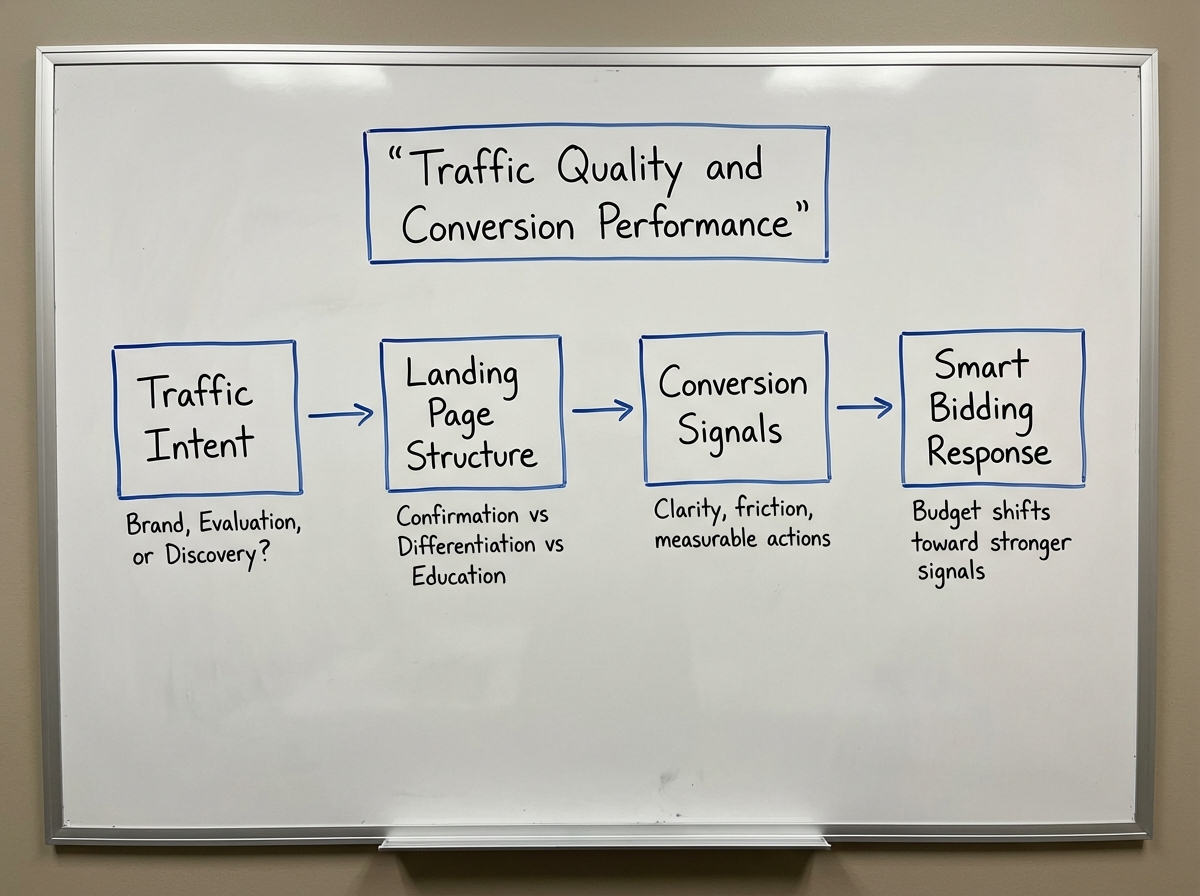
Traffic Quality and Its Impact on Conversion Performance
Conversion rate is often evaluated at the landing page level. In practice, it is also strongly influenced by traffic quality. A landing page receiving high-intent branded search traffic behaves differently from one receiving broad generic queries or top-of-funnel keyword traffic.
Brand search traffic typically arrives with prior familiarity. These users often look for confirmation – shipping times, availability, or pricing clarity. Here, removing friction and accelerating the path to conversion matters more than additional persuasion.
Generic non-branded searches often reflect evaluation. Users may still be comparing categories and alternatives. In this case, the landing page should focus on differentiation rather than direct response.
Broad match campaigns with automated bidding can bring mixed intent into the same landing page. This is where clear messaging and structure matter significantly – performance becomes difficult to interpret when different intents are blended together.
This is why landing page optimization cannot be separated from traffic strategy. Before adjusting layouts or headlines, it is often more useful to analyze the dominant intent behind the traffic source. Evaluate whether the page is structured for confirmation, evaluation, or discovery – and whether distinct intent segments are being treated as one.
Core Landing Page Optimization Strategies That Increase Conversions
Message Match Between Ad and Page
Message match is one of the most overlooked aspects of landing page conversion optimization. When a user clicks on an ad, there is an expectation shaped by the keyword, the ad copy, and the offer framing. If the landing page shifts focus, doesn’t deliver the promised benefit, or if it presents a different value proposition, conversion rates often decline.
This becomes especially relevant in campaign types where targeting is broader or more automated. Dynamic Search Ads, broad match with Smart Bidding, or Performance Max campaigns often bring in a wider range of queries under one structure. In these cases, headline clarity and value proposition alignment are critical. If the landing page does not clearly reflect what triggered the ad, conversion behavior can become inconsistent. Shopping traffic is even more sensitive to alignment. Users typically click based on specific product data – title, price, promotion, availability. Any discrepancy between feed information and on-page content can reduce trust and affect performance.
In automated bidding environments, consistent message alignment often leads to more stable conversion patterns. The highest-performing campaigns maintain tight alignment between the user’s search query, the ad copy, and the landing page content and call-to-action. When all three reflect the same intent and value proposition, users are more likely to click, stay, and convert. This consistency not only improves short-term performance metrics such as Quality Score and CPC, but also creates more predictable conversion behavior over time – benefiting the whole account and enabling more reliable optimization than surface-level design changes.
Structural Clarity Over Visual Persuasion
Structural clarity means one primary action, a clear hierarchy of information, visible differentiation early on, and predictable navigation, especially on mobile. Pages with multiple calls to action, parallel offers, or unclear positioning increase cognitive load. When users need to figure out what the page is about before deciding whether to convert, they are more likely to leave.
Users expect clarity, and also fast load time. This is particularly relevant on mobile, where attention is shorter and navigation tolerance lower. In many cases, improving structure helps improve performance more reliably than adding persuasive elements.
Reducing Decision Friction
Particularly in eCommerce, friction often appears as unclear pricing, hidden shipping costs, vague return policies, or missing trust signals. In high-CPC B2B environments, friction may come from long forms, uncertainty about who the solution is for, or insufficient credibility signals.
When acquisition costs are high, each user who bounces quickly has a direct cost impact. Reducing friction doesn’t mean oversimplifying decisions, but rather removing unnecessary uncertainty. The goal shouldn’t be to pressure the user into action, but to make the decision easier to evaluate.
Intent- and Context-Based Page Variants
When there is enough volume and segmentation, different intent categories often need different page structures. Generic keywords may require more education framing. Product-specific queries often need direct offers and clear pricing. Retargeted audiences typically benefit from shorter paths and fewer explanations.
That said, in lower-volume accounts, fragmenting landing pages excessively can reduce data clarity. Page variants make sense only when the traffic is large enough to point towards consistent patterns. Without sufficient volume, focusing on clearer positioning within a single structure is often more effective.
How Landing Page Optimization Connects to Google Ads Performance
In Google Ads accounts using automated bidding, landing pages do more than convert traffic – they shape how the system allocates budget. Smart Bidding evaluates who converts, under which queries, and at what cost. When conversion behavior varies significantly across intent segments on the same page, the system shifts spend toward the segments that produce the most stable and frequent results.
For example, branded traffic may convert consistently while non-brand traffic struggles due to unclear differentiation. In that case, spend often shifts toward branded queries.
This dynamic is one of the reasons why separating brand and non-brand traffic at the campaign level is often recommended. Branded queries typically convert at higher rates and lower CPCs, which can inflate overall performance metrics. Without separation, the algorithm may prioritize branded traffic instead of investing in non-branded queries that drive new customer acquisition. ROAS looks healthy, but growth stalls.
Clear intent segmentation and aligned landing pages produce cleaner conversion signals. That clarity not only improves budget allocation, but can also contribute to stronger Quality Scores – which are influenced by ad relevance, expected CTR, and landing page experience – ultimately affecting CPCs, ad visibility, and overall cost efficiency over time. Landing page optimization therefore impacts not only conversion rates, but also traffic quality and how the account evolves over time.
Landing Page Optimization in eCommerce vs Lead Generation
While the underlying logic stays the same, the commercial context changes how landing page optimization should be approached.
Landing Page Optimization in eCommerce
Decision cycles in eCommerce are typically shorter, but comparison behavior is common. Users might move between different products and brands before converting. Small uncertainties about shipping cost or unclear stock status can meaningfully affect outcomes.
For brands running Shopping campaigns or Performance Max, alignment between feed data and landing page content becomes especially important. When product titles, pricing, or promotions are different from on-page information, user trust weakens and conversion probability declines.
Landing Page Optimization in Lead Generation
In lead generation, the primary exchange is information – users share their details in return for value. Reducing friction alone is rarely sufficient. If the next step in the process – whether a consultation, a proposal, or a demo – is unclear, hesitation increases even when the form appears simple.
Longer sales cycles also change the role of the landing page. It may not close the deal, but it shapes expectations and filters intent. A page that maximizes form submissions without clarifying who the solution is actually for can create volume while lowering lead quality. Here, landing page conversion optimization is less about speed and more about alignment between promise and process.
Conclusion: Conversion as a System Outcome
Landing page optimization is not just about design and visuals. It requires broader strategic thinking. When a landing page underperforms, the first question shouldn’t be “What element should we change?”. Instead, ask if the page matches the user intent and if the signals sent to users and bidding systems are clear. In most performance-driven environments, landing page optimization works best when treated as part of the overall acquisition strategy rather than as a standalone project.

Ready To Start Scaling Today?
Scaling Your Favorite eCommerce Brands To The Highest Levels Through Google & YouTube Ads.

.svg)
Get Smarter About How To Scale Your Brand...
Discover Insider Knowledge On How We Scale Brands From 7 Figures All The Way Up To 8-9 Figures With Google Ads.
.svg)
.svg)
"The best Google ads agency there is. You only need to look at the quality of clients and the reviews to understand Jackson and his team are the real deal."

"One of the best in the agency space, great service and exceptional results. Since signing on with Jackson he has become one of our greatest assets when scaling."

"Top tier team & service delivery. Jackson is relentless when it comes to fulfilment & client needs. His attention to detail during the onboarding process ensured exponential results for my coaching business. If you're looking to elevate your ad results & learn a tone of new options/skills that can be implemented to drive more sales to your business then I'd strongly recommend Echelonn."

"From the very first conversation with Jackson and his team, it was clear that we had found a Google Ads agency that prioritises results above all else. Their collaboration between data-driven experts and a skilled copywriter creates a dynamic duo for Google advertising success..."

"Been working with them for 9 months and it's been a great experience. Jackson and his team know what they are doing and always goes above and beyond. If you're looking for a reliable Google ads agency this is the one."

"The best Google ads agency there is. You only need to look at the quality of clients and the reviews to understand Jackson and his team are the real deal."
"One of the best in the agency space, great service and exceptional results. Since signing on with Jackson he has become one of our greatest assets when scaling."
"Top tier team & service delivery. Jackson is relentless when it comes to fulfilment & client needs. His attention to detail during the onboarding process ensured exponential results for my coaching business. If you're looking to elevate your ad results & learn a tone of new options/skills that can be implemented to drive more sales to your business then I'd strongly recommend Echelonn."
"From the very first conversation with Jackson and his team, it was clear that we had found a Google Ads agency that prioritises results above all else. Their collaboration between data-driven experts and a skilled copywriter creates a dynamic duo for Google advertising success..."
"Been working with them for 9 months and it's been a great experience. Jackson and his team know what they are doing and always goes above and beyond. If you're looking for a reliable Google ads agency this is the one."
More Articles Like This.
Find answers to common queries about our services and how we can help you.
.svg)
Google Ads Optimization Score: Should You Trust It?
What Is a Good CTR for Google Ads?
Why More Google Ads Spend Doesn't Always Mean More Revenue
How To Rank Your Google Shopping Ads Multiple Times
Why Your Google Ads Scale Breaks After $X Per Day
How to Tell if Your Google Ads Agency Is Underperforming
Why Your Performance Max Campaign Gets Clicks but No Sales
.png)
Why Your Google Ads Budget Isn't Spending (And How to Fix It)

The Right Way to Run Google Dynamic Search Ads
How to Get New Customers With Google Ads in 2026
Why Your Google Ads CPA Keeps Increasing and How to Reduce It
What Is a Good ROAS for eCommerce Businesses?
How to Set Up Google Ads Conversion Tracking the Right Way
How Much Does a Google Ads Agency Cost?
Why Your Google Ads Are Not Converting
.png)
Average CPC in Google Ads by Industry (And What It Means for Your Strategy)
Performance Max vs. Shopping Campaigns: Which One is Better?

Why Your Google Shopping Ads Get Impressions But No Clicks (Image Optimization Guide)
Why Your Google Ads Are Not Showing

YouTube Ads Targeting Framework That's Driven $10M+ for eCommerce Brands

What Professional Google Shopping Ads Management Looks Like
How Much Do Google Ads Cost in 2026?

Should Your Business Use Google Search Ads or Performance Max?

Performance Max Best Practices for Sustainable Growth
.png)
Google Shopping Ads Audience Targeting: What Actually Impacts Performance
.png)
How to Write Google Search Ads That Actually Convert
.png)
6 Google Shopping Feed Best Practices That Drive Better ROAS
%20(1).png)
How to Get Your Products Recommended by AI (ChatGPT, Google AI & More)
.png)
Common Google Ads Myths That Cost Businesses Money
.png)
7 Benefits of Google Shopping Ads for Your eCommerce Business
.png)
How to Switch Google Ads Agency Without Losing Performance or Data
.png)
Demand Capture vs Demand Generation: Where Google Ads Fits
.png)
How to Prepare Your Business for Working With a Google Ads Agency

How to Avoid Wasting Budget on the Wrong Searches With Google Ads Keyword Match Types
Google Ads Account Ownership: What Businesses Should Know Before Hiring an Agency
Landing Page Optimization Strategies That Increase Conversions
SEO and Google Ads: How Search Engine Optimization and Paid Search Work Together
Types of Remarketing in Google Ads: How Each One Works and When to Use It
Google Ads Keyword Research: How to Find Keywords That Actually Convert
.png)
What Is Google Performance Max and How Does It Work?
.png)
How Advertorials Support High-Intent Google Ads Funnels
%20(Canva%20Template).png)
How Audience Targeting Works in Google Search Ads (and When to Use It)

Google Ads for New Brands: What to Know Before Spending Your First Dollar
.png)
What Is a PPC Agency – and When It Makes Sense to Hire One
.png)
How to Improve Your Google Ads Conversion Rate

.png)
The Right Way to Link Shopify and Google Ads for Scalable Growth
Google Shopping Campaigns Setup Guide 2025
Confessions of a Google Ads Auditor: The Worst Mistakes We See Inside eCom Accounts
How to Spy on Competitor Google Ads: Complete 2025 Guide
%20(2).png)
7 Questions to Ask Before Hiring a Google Ads Consultant
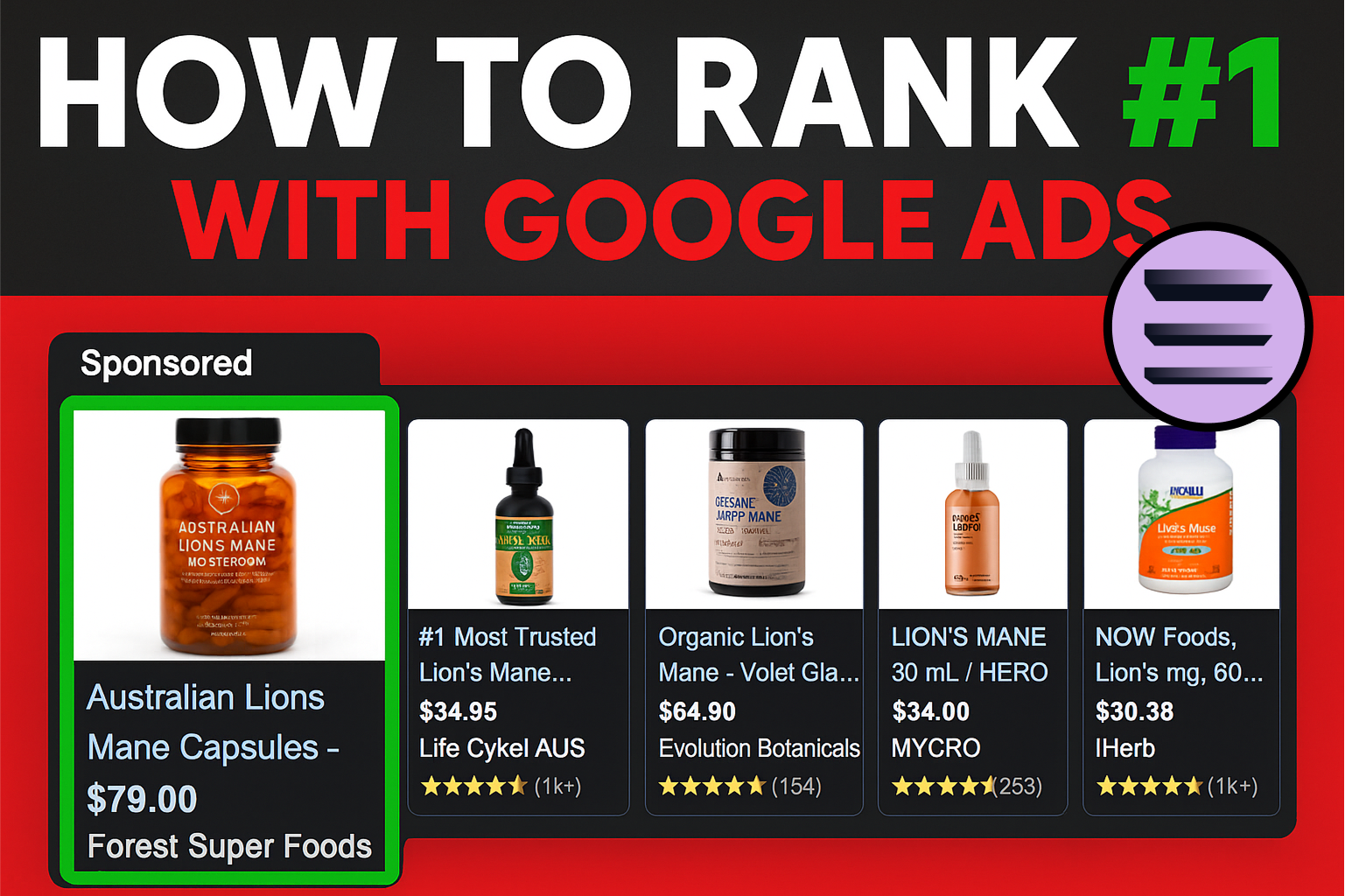
How to Rank #1 on Google Ads: Complete Shopping & Search Guide 2025
.png)
Learning Google Ads in 2025: The Roadmap Nobody Talks About
%20(1).png)
What Makes a Google Ads Specialist Worth $10,000/Month?

Why Cheap Google Ads Consulting Costs You $180,000+ in Lost Revenue
.png)
Why 99% of Google Ads Experts Fail (& How to Find One That Won’t)
.png)
5 Google Product Feed Fixes for eCom Growth
.png)
Google Ads Campaign Structure: Why 95% of Brands Waste Budget on Mixed Traffic

In-House vs Agency Google Ads: Which Delivers Better ROI in 2025?
.png)
How to Scale Google Ads With a Small Budget | Setup and Optimization

Google Shopping Optimization: 11 Proven Tactics for Maximum ROAS
%20(3).png)
eCom Growth Strategy: How We Scaled a Supplement Brand From $1.9M to $8.6M With Google Ads
%20(4).png)
Google Merchant Center Fix: How to Improve Rankings With Accurate Shipping Times

CTR Is Misunderstood by 95% of the PPC Industry (What to Optimise for Instead)
.png)
Google Ads AI | Manual vs Automated Campaign Performance

Complete YouTube Ads Guide 2025 | 3 Formats, 5 Principles, Proven Results
%20(2).png)
eCom Growth Strategy With Google Ads in 2025
.png)
Google Marketing Live 2025: 11 Key Takeaways for Marketers
%20(1).png)
YouTube Advertising Strategy: How to Drive Results Across Every Format
Google Shopping Feed Optimisation: Tips for Better Results

How Long Does it Take for Google Ads to Work?

Search Ad Strategies to Maximize Sales with Google ads for eCommerce (2024)

2025 Google Shopping Ads: Ultimate Guide, Benchmarks, and Pricing Breakdown

Maximizing ROI with Advanced Google Shopping Bid Strategies and Automated Bidding