
.svg)
What Is a Good ROAS for eCommerce Businesses?


Return on Ad Spend (ROAS) is one of the most common metrics advertisers use to measure success, but it's also one of the most misunderstood. Some brands are happy with a 3x ROAS. Others aim for a ROAS of 10x or more. The challenge is that ROAS doesn't exist in a vacuum. A "good" ROAS depends on your margins, growth goals, customer lifetime value (CLV), and even the type of campaign you're running.
In this article, we'll break down what a good ROAS actually looks like for eCommerce brands, why benchmarks can be misleading, and how to evaluate Google Ads performance in a way that supports profitable long-term growth.
The Short Answer: What Is a Good ROAS?
There is no universal ROAS benchmark that applies to every eCommerce business. Many brands target a ROAS between 3x and 5x as a starting point, meaning they generate $3-$5 in revenue for every $1 spent on advertising. But whether that number is actually "good" depends entirely on your margins, growth goals, and customer acquisition strategy.
The type of campaign also matters. Brand Search campaigns often generate double-digit ROAS because they capture existing demand, while prospecting campaigns such as Performance Max, Non-Brand Search, or some Shopping campaigns often operate at much lower ROAS levels. That doesn't make them worse campaigns. In many cases, they're responsible for acquiring the new customers that drive future growth. This is also why separating branded and non-branded traffic is so important when evaluating Google Ads performance.
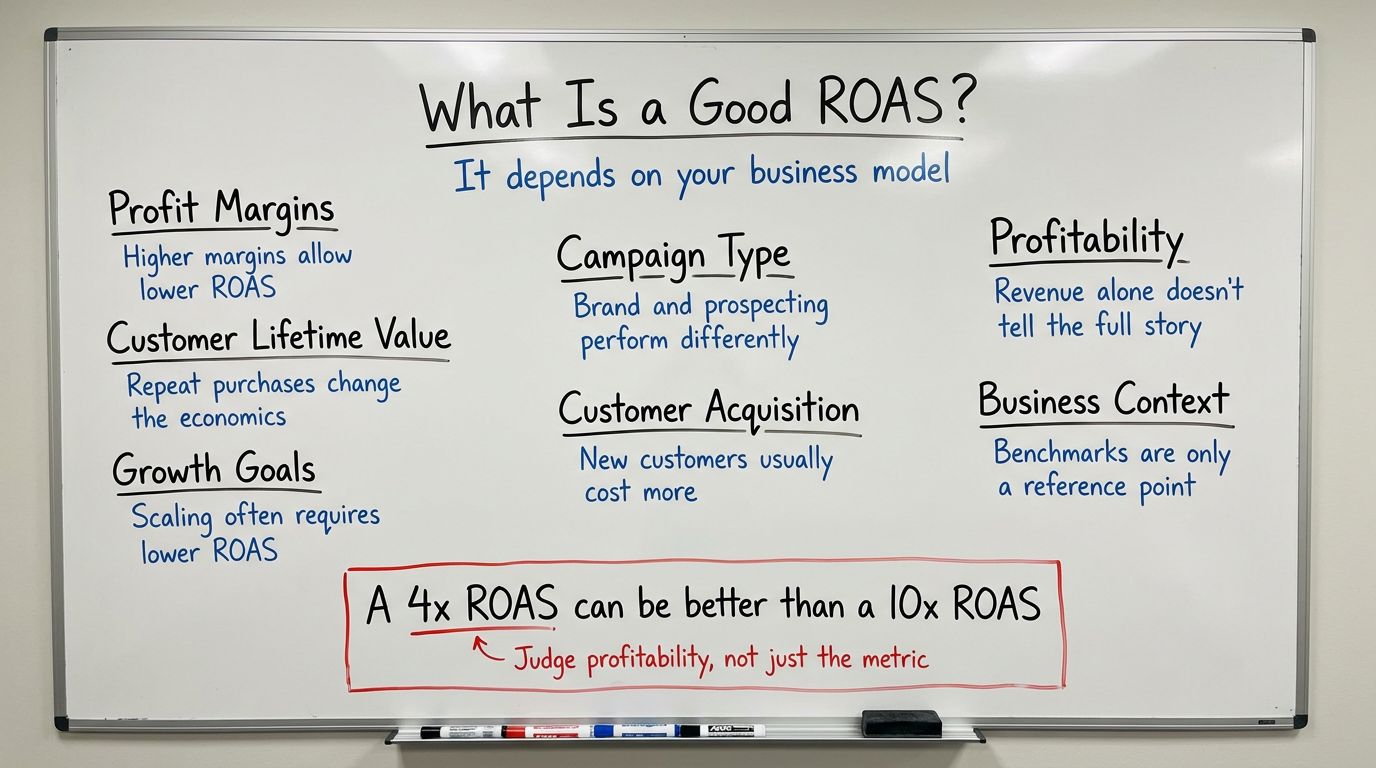
That's why ROAS should always be evaluated in context. A 10x ROAS isn't automatically better than a 4x ROAS if the lower-ROAS campaign is generating more profitable growth for the business.
Average ROAS Benchmarks for eCommerce
While every business is different, the table below shows the ROAS ranges commonly seen across different Google Ads campaign types in eCommerce.
These numbers should be treated as directional benchmarks rather than performance targets. A ROAS that looks excellent for one campaign type could be disappointing for another.
Why There Is No Universal “Good” ROAS
Profit Margins Matter
The higher your margins, the more flexibility you have when it comes to advertising costs. A business selling products with a 70% margin can often operate profitably at a much lower ROAS than a business working with 20% margins. This is why the same ROAS can be highly profitable for one business and unsustainable for another.
Customer Lifetime Value Changes Everything
Not every customer generates value from their first purchase alone. Many eCommerce brands rely on repeat purchases, subscriptions, or strong customer retention to maximise lifetime value. In those cases, acquiring a customer at a lower ROAS can still make perfect business sense if that customer continues to buy from you over time.
Growth vs Profitability
Brands focused on aggressive growth often accept lower ROAS targets in exchange for acquiring more customers and increasing market share. More conservative businesses may prioritise profitability and require significantly higher returns before scaling spend.
Neither approach is inherently right or wrong. The key is making sure your ROAS target aligns with your overall business objectives rather than chasing an arbitrary benchmark.
What Metrics Matter Alongside ROAS?
One of the most common Google Ads mistakes is evaluating performance through a single metric while ignoring the broader context of the account. A campaign can deliver a strong ROAS while generating very little volume, or a lower ROAS while driving significant revenue growth, which is why understanding your overall Google Ads costs is equally important.
That's why experienced advertisers look at several metrics together. Cost Per Acquisition (CPA) helps measure how efficiently customers are acquired, conversion rate shows how effectively traffic turns into sales, and profit margin determines how much revenue actually reaches the bottom line. Depending on your business model, CLV can also play a major role when evaluating long-term profitability.
How to Improve ROAS Without Limiting Growth
Improving ROAS doesn't always mean cutting spend or chasing cheaper traffic. In many cases, the biggest gains come from improving what happens after the click rather than reducing advertising costs.
Here are a few areas worth focusing on:
- Improve your conversion rate: A better website experience can increase revenue without increasing ad spend.
- Optimise your product feed: Strong product titles, images, and attributes can improve visibility and click-through rates.
- Fix tracking issues & feed the algorithm: Smart Bidding relies heavily on accurate data. Ensure your tracking is flawless and that you provide enough testing budget to generate at least 1 to 2 conversions per day per campaign. Without this baseline volume, Google's system cannot optimize effectively toward your target ROAS.
- Segment campaigns strategically: Separate high-margin, best-selling, and seasonal products into distinct campaigns or asset groups so bidding strategies can reflect their true business value.
- Increase Average Order Value (AOV): Bundles, upsells, cross-sells, and free shipping thresholds can increase revenue from existing traffic and improve ROAS without increasing ad spend.
- Prioritise high-value customers: A campaign with a lower ROAS may still be more valuable if it attracts customers with higher lifetime value.
The goal isn't to maximise ROAS at all costs. It's to find the point where your advertising generates the greatest amount of profitable growth.
Final Takeaway: A Good ROAS Depends on Your Business
There is no universal definition of a "good" ROAS. The right target depends on your margins, growth objectives, customer lifetime value, and the role each campaign plays within your overall marketing strategy.
Instead of comparing your results to a generic benchmark, focus on whether your campaigns are generating profitable growth for the business. A lower ROAS that consistently acquires valuable new customers can be far more impactful than a higher ROAS that simply captures demand that already exists. Ultimately, the best ROAS is the one that supports your long-term business goals, not the one that looks best in a report.

Ready To Start Scaling Today?
Scaling Your Favorite eCommerce Brands To The Highest Levels Through Google & YouTube Ads.

.svg)
Get Smarter About How To Scale Your Brand...
Discover Insider Knowledge On How We Scale Brands From 7 Figures All The Way Up To 8-9 Figures With Google Ads.
.svg)
.svg)
"The best Google ads agency there is. You only need to look at the quality of clients and the reviews to understand Jackson and his team are the real deal."

"One of the best in the agency space, great service and exceptional results. Since signing on with Jackson he has become one of our greatest assets when scaling."

"Top tier team & service delivery. Jackson is relentless when it comes to fulfilment & client needs. His attention to detail during the onboarding process ensured exponential results for my coaching business. If you're looking to elevate your ad results & learn a tone of new options/skills that can be implemented to drive more sales to your business then I'd strongly recommend Echelonn."

"From the very first conversation with Jackson and his team, it was clear that we had found a Google Ads agency that prioritises results above all else. Their collaboration between data-driven experts and a skilled copywriter creates a dynamic duo for Google advertising success..."

"Been working with them for 9 months and it's been a great experience. Jackson and his team know what they are doing and always goes above and beyond. If you're looking for a reliable Google ads agency this is the one."

"The best Google ads agency there is. You only need to look at the quality of clients and the reviews to understand Jackson and his team are the real deal."
"One of the best in the agency space, great service and exceptional results. Since signing on with Jackson he has become one of our greatest assets when scaling."
"Top tier team & service delivery. Jackson is relentless when it comes to fulfilment & client needs. His attention to detail during the onboarding process ensured exponential results for my coaching business. If you're looking to elevate your ad results & learn a tone of new options/skills that can be implemented to drive more sales to your business then I'd strongly recommend Echelonn."
"From the very first conversation with Jackson and his team, it was clear that we had found a Google Ads agency that prioritises results above all else. Their collaboration between data-driven experts and a skilled copywriter creates a dynamic duo for Google advertising success..."
"Been working with them for 9 months and it's been a great experience. Jackson and his team know what they are doing and always goes above and beyond. If you're looking for a reliable Google ads agency this is the one."
More Articles Like This.
Find answers to common queries about our services and how we can help you.
.svg)
How To Rank Your Google Shopping Ads Multiple Times
Why Your Google Ads Scale Breaks After $X Per Day
How to Tell if Your Google Ads Agency Is Underperforming
Why Your Performance Max Campaign Gets Clicks but No Sales
.png)
Why Your Google Ads Budget Isn't Spending (And How to Fix It)

The Right Way to Run Google Dynamic Search Ads
How to Get New Customers With Google Ads in 2026
Why Your Google Ads CPA Keeps Increasing and How to Reduce It
What Is a Good ROAS for eCommerce Businesses?
How to Set Up Google Ads Conversion Tracking the Right Way
How Much Does a Google Ads Agency Cost?
Why Your Google Ads Are Not Converting
.png)
Average CPC in Google Ads by Industry (And What It Means for Your Strategy)
Performance Max vs. Shopping Campaigns: Which One is Better?

Why Your Google Shopping Ads Get Impressions But No Clicks (Image Optimization Guide)
Why Your Google Ads Are Not Showing

YouTube Ads Targeting Framework That's Driven $10M+ for eCommerce Brands

What Professional Google Shopping Ads Management Looks Like
How Much Do Google Ads Cost in 2026?

Should Your Business Use Google Search Ads or Performance Max?

Performance Max Best Practices for Sustainable Growth
.png)
Google Shopping Ads Audience Targeting: What Actually Impacts Performance
.png)
How to Write Google Search Ads That Actually Convert
.png)
6 Google Shopping Feed Best Practices That Drive Better ROAS
%20(1).png)
How to Get Your Products Recommended by AI (ChatGPT, Google AI & More)
.png)
Common Google Ads Myths That Cost Businesses Money
.png)
7 Benefits of Google Shopping Ads for Your eCommerce Business
.png)
How to Switch Google Ads Agency Without Losing Performance or Data
.png)
Demand Capture vs Demand Generation: Where Google Ads Fits
.png)
How to Prepare Your Business for Working With a Google Ads Agency

How to Avoid Wasting Budget on the Wrong Searches With Google Ads Keyword Match Types
Google Ads Account Ownership: What Businesses Should Know Before Hiring an Agency
.png)
Landing Page Optimization Strategies That Increase Conversions
SEO and Google Ads: How Search Engine Optimization and Paid Search Work Together
Types of Remarketing in Google Ads: How Each One Works and When to Use It
Google Ads Keyword Research: How to Find Keywords That Actually Convert
.png)
What Is Google Performance Max and How Does It Work?
.png)
How Advertorials Support High-Intent Google Ads Funnels
%20(Canva%20Template).png)
How Audience Targeting Works in Google Search Ads (and When to Use It)

Google Ads for New Brands: What to Know Before Spending Your First Dollar
.png)
What Is a PPC Agency – and When It Makes Sense to Hire One
.png)
How to Improve Your Google Ads Conversion Rate

.png)
The Right Way to Link Shopify and Google Ads for Scalable Growth
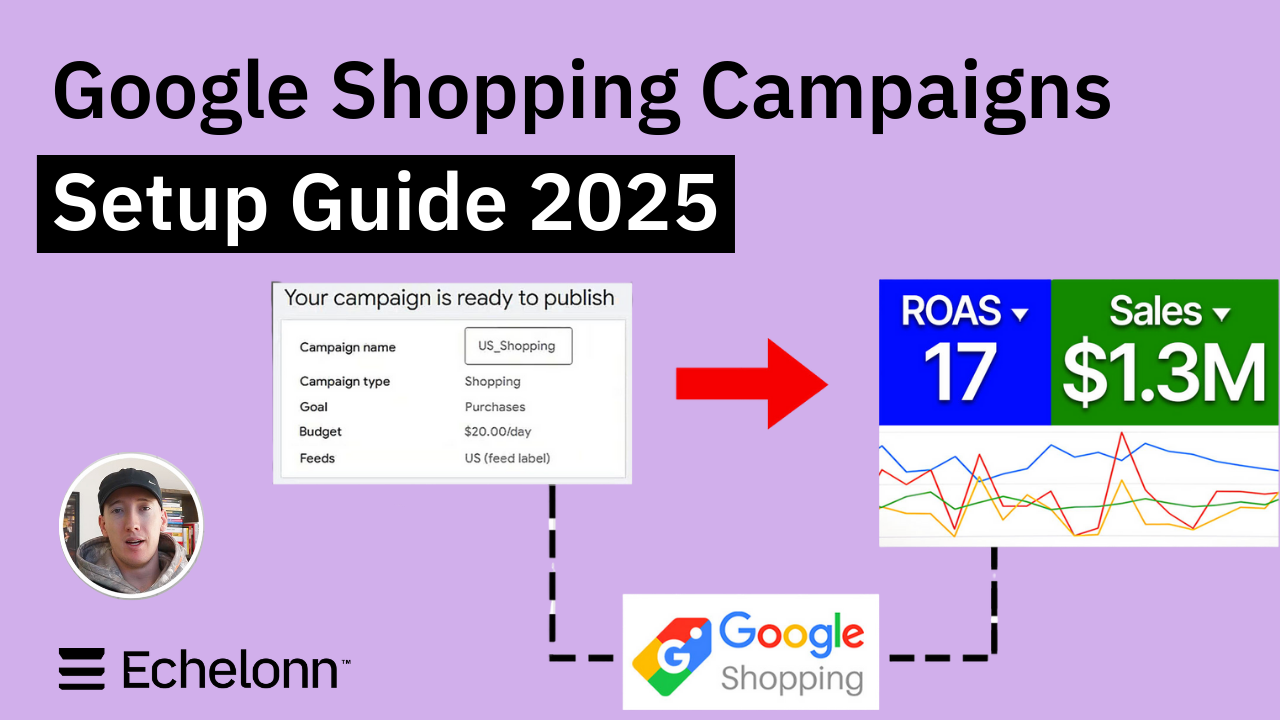
Google Shopping Campaigns Setup Guide 2025
Confessions of a Google Ads Auditor: The Worst Mistakes We See Inside eCom Accounts

How to Spy on Competitor Google Ads: Complete 2025 Guide
%20(2).png)
7 Questions to Ask Before Hiring a Google Ads Consultant
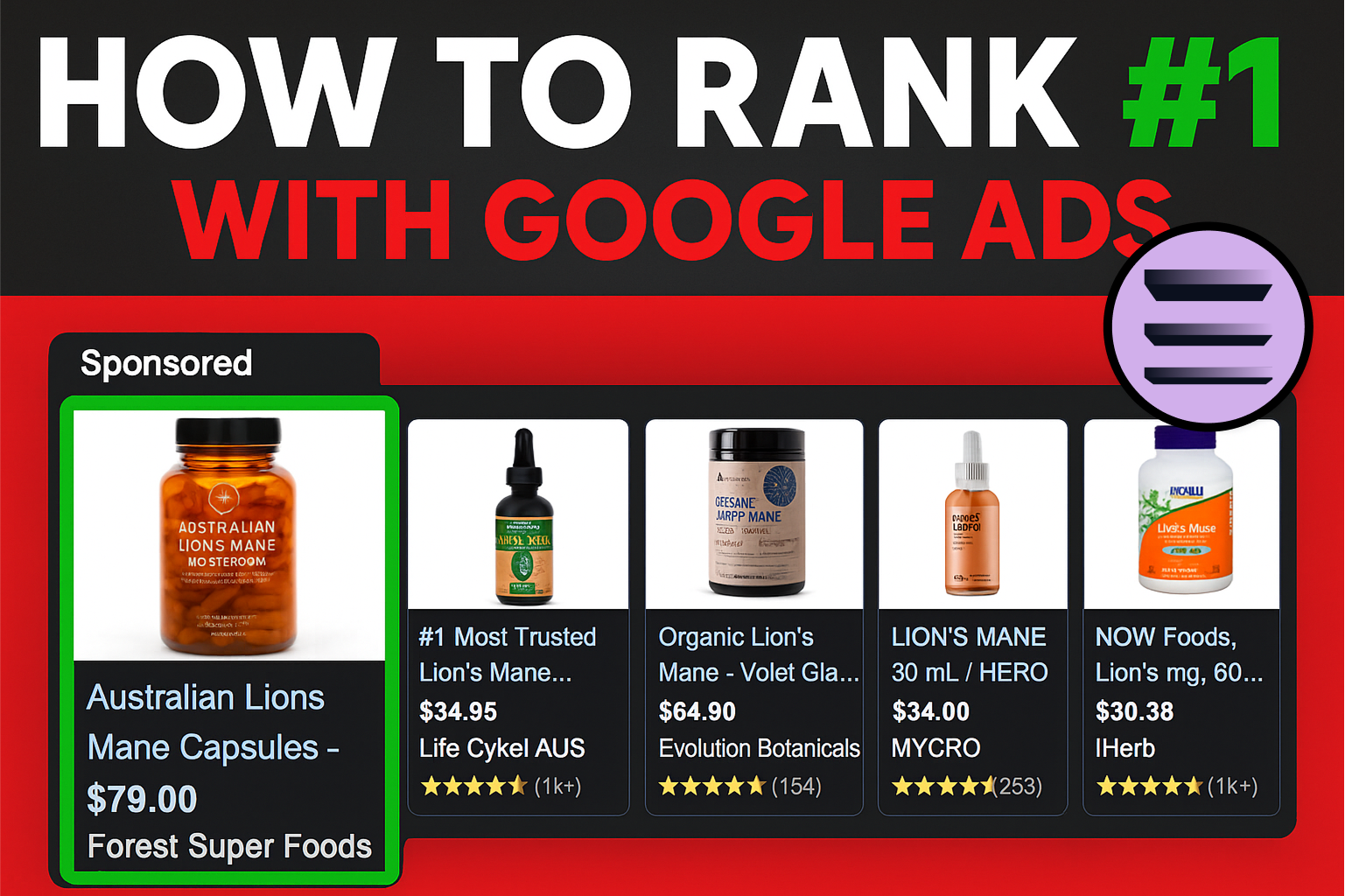
How to Rank #1 on Google Ads: Complete Shopping & Search Guide 2025
.png)
Learning Google Ads in 2025: The Roadmap Nobody Talks About
%20(1).png)
What Makes a Google Ads Specialist Worth $10,000/Month?

Why Cheap Google Ads Consulting Costs You $180,000+ in Lost Revenue
.png)
Why 99% of Google Ads Experts Fail (& How to Find One That Won’t)
.png)
5 Google Product Feed Fixes for eCom Growth
.png)
Google Ads Campaign Structure: Why 95% of Brands Waste Budget on Mixed Traffic

In-House vs Agency Google Ads: Which Delivers Better ROI in 2025?
.png)
How to Scale Google Ads With a Small Budget | Setup and Optimization

Google Shopping Optimization: 11 Proven Tactics for Maximum ROAS
%20(3).png)
eCom Growth Strategy: How We Scaled a Supplement Brand From $1.9M to $8.6M With Google Ads
%20(4).png)
Google Merchant Center Fix: How to Improve Rankings With Accurate Shipping Times

CTR Is Misunderstood by 95% of the PPC Industry (What to Optimise for Instead)
.png)
Google Ads AI | Manual vs Automated Campaign Performance

Complete YouTube Ads Guide 2025 | 3 Formats, 5 Principles, Proven Results
%20(2).png)
eCom Growth Strategy With Google Ads in 2025
.png)
Google Marketing Live 2025: 11 Key Takeaways for Marketers
%20(1).png)
YouTube Advertising Strategy: How to Drive Results Across Every Format
Google Shopping Feed Optimisation: Tips for Better Results

How Long Does it Take for Google Ads to Work?

Search Ad Strategies to Maximize Sales with Google ads for eCommerce (2024)

2025 Google Shopping Ads: Ultimate Guide, Benchmarks, and Pricing Breakdown

Maximizing ROI with Advanced Google Shopping Bid Strategies and Automated Bidding