
.svg)
How Much Do Google Ads Cost in 2026?


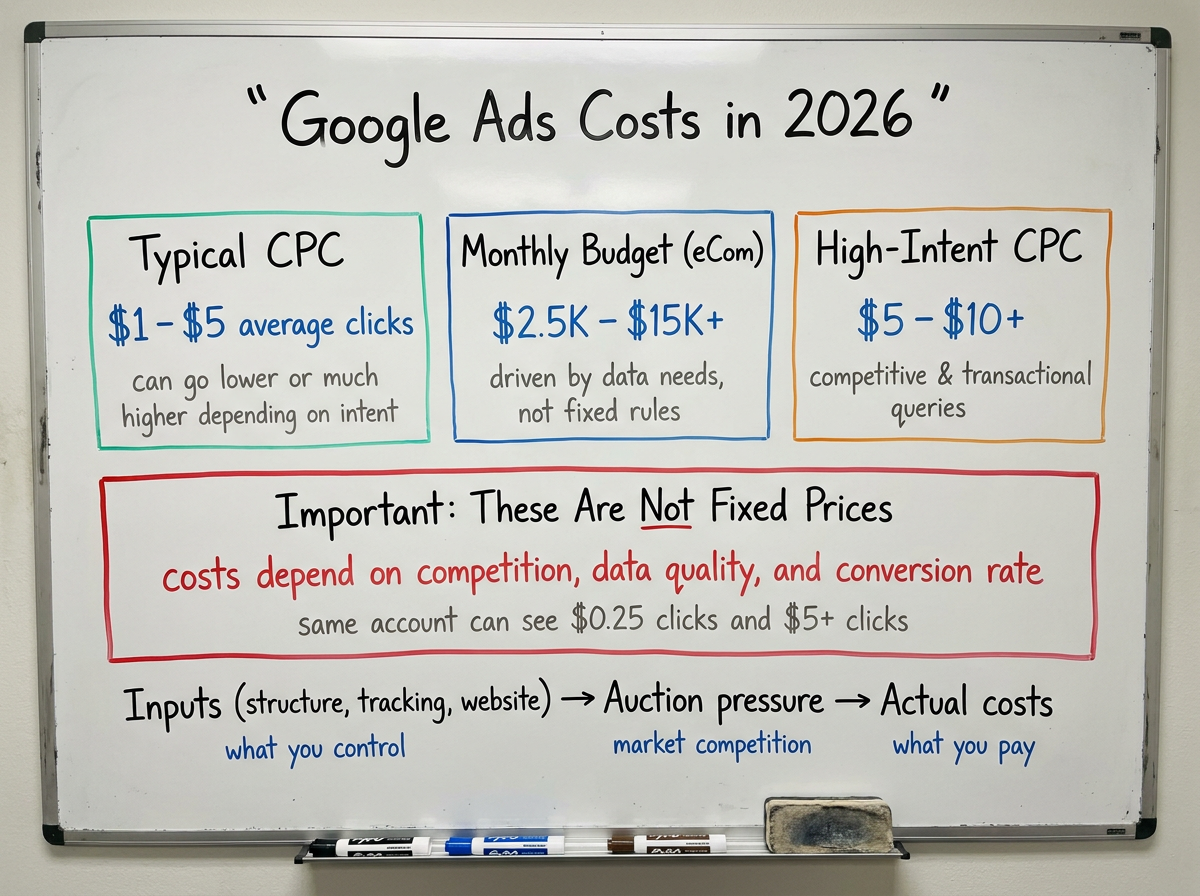
I’ll save you time searching for a definite answer: Google Ads don’t have a fixed cost in 2026. You decide how much you spend through your account structure, campaigns, bids, and budgets. The market decides the rest.
That’s why you can see clicks at $0.25 in one campaign and $5+ in another, even within the same account. Costs are going up, though. More advertisers, more automation, and now AI-driven search are changing how auctions work and how much you end up paying for clicks and customers. This article breaks down what Google Ads actually cost in 2026, what drives those costs, and where most companies get it wrong.
The Short Answer: How Much Do Google Ads Cost in 2026?
For most small-to-medium eCom brands, monthly spend usually lands somewhere between $2,500 and $15,000. For larger businesses, it’s common to see budgets scale well beyond that. Not because that’s a requirement, but because that’s what it often takes to generate enough data and compete in the auction.
While there is no fixed price for Google Ads, most accounts pay between $1 and $5 per click. High-intent keywords (transactional, like “buy [product]…”) can easily go higher. Lower-intent traffic (informational, like “how to…”), especially in eCom prospecting, can be significantly cheaper.
The easiest way to estimate your potential CPC is through Google Keyword Planner. Search for your branded terms and then compare them with broader non-branded queries in your category. In most cases, branded traffic will have lower CPC and stronger intent, while non-branded searches are more competitive and expensive.

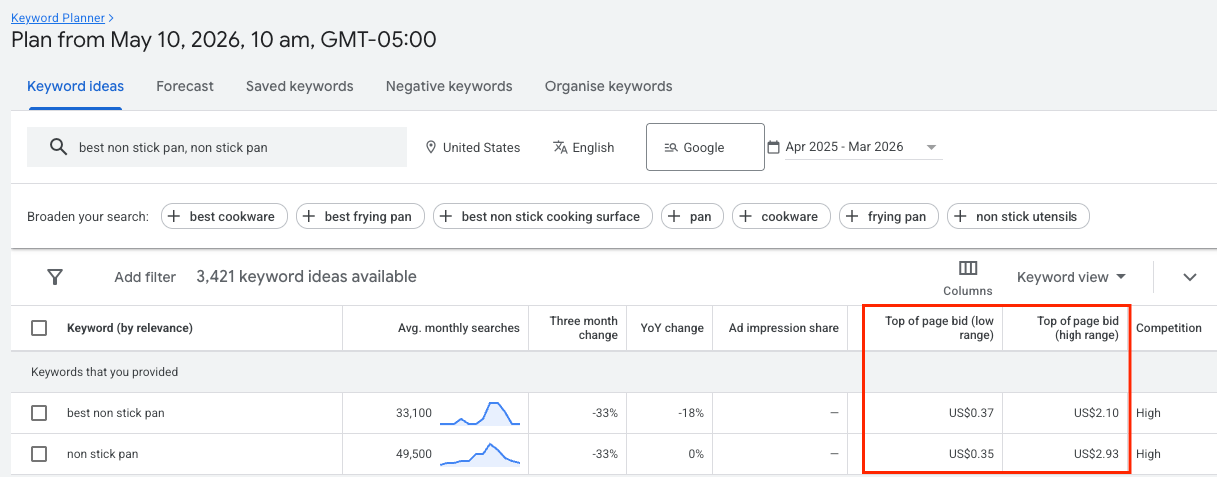
CPC is still a useful signal. It tells you how competitive your keywords are and how efficiently you’re buying traffic. If your CPC starts rising, it usually points to stronger competition or a drop in Quality Score.
But CPC on its own doesn’t tell you if your campaigns are working. You can pay $5 per click and still be profitable. You can pay $0.30 and lose money. What matters is what happens after the click.
That’s also where most accounts fall apart. They focus on lowering CPC instead of improving the factors that actually drive the sale. This includes the messaging in your ads, the speed and relevance of your landing page, and the overall friction of your checkout process. If your website doesn't convert, even the cheapest traffic in the world is a waste of money.
What Actually Impacts Your Google Ads Cost
Google Ads cost is shaped by a number of core factors that show up in every account. The first is your industry. Some spaces are simply more competitive. Legal, finance, and high-ticket products will always have higher CPCs than most eCom categories. Even within eCommerce, niche markets and high-demand products naturally force you to pay more to stay visible.
Then there’s auction pressure. If more advertisers are bidding on the same queries, your costs go up. It doesn’t matter how good your setup is, you’re still competing in the same auction.
Your bidding strategy also impacts Google Ads cost. Manual CPC gives you more control over how much you’re willing to pay, while automated strategies like Maximise Conversions, tCPA, or tROAS adjust bids dynamically based on the likelihood of a conversion.
Different campaign types behave differently. Search, Shopping, and PMax each come with different intent levels and auction dynamics, which can influence your average CPC and overall efficiency.
Quality Score still plays a role. Better ads and more relevant landing pages can lower your cost per click. Google still uses Quality Score as part of Ad Rank, which means advertisers with a stronger user experience can often outrank competitors bidding more aggressively.
Your website’s conversion rate directly impacts how much you can afford to pay. If your site converts at 3%, you can bid more aggressively than a competitor converting at 1% while maintaining the same profitability. Improving your site gives you more room in the auction to outbid others for the best traffic.
In 2026, data is the fuel for automated bidding. If your tracking is broken or incomplete, you’re feeding bad signals into the system. The algorithm then struggles to find the right users, leading to inefficient bidding and, ultimately, higher costs for lower-quality results.
And finally, how you use automation. Smart Bidding is powerful, but it’s designed to win. Without proper constraints like tROAS or tCPA, it can push bids higher to secure conversions. The goal is to use automation for efficiency while keeping enough control to avoid overpaying.
Why Google Ads Costs Keep Going Up
More Advertisers In the Auction
The most obvious reason why Google Ads costs keep going up is simply because of competition, especially in eCommerce. As more brands bid on the same keywords, the auction gets busier, more competitive, and CPC rises. This is most visible on high-intent queries, where multiple advertisers are willing to pay for the same customer.
Smart Bidding Is Now the Default
Most accounts now use automated bidding strategies that optimise for conversions. That changes how auctions behave. Instead of bidding fixed amounts for clicks, the system pushes bids higher when it predicts a conversion. Over time, this increases the average CPC across the auction. You’re no longer competing just on keywords, but on who can afford to pay more for a conversion.
AI-Driven Search Is Changing CPC
Search behaviour is shifting. AI Overviews and other formats answer more queries directly in the results page. While your customers can get your products recommended directly by AI, it also reduces the number of clicks available, especially for informational searches. At the same time, advertisers are still competing for visibility. With fewer traditional ad slots but the same (or higher) advertiser demand, the pressure on CPC increases. You are paying more for visibility in a shrinking amount of ad space.
How Much Budget Do You Need to Start With Google Ads?
Your starting budget shouldn’t be a random number. It should be based on how much data you need to generate for the algorithm to learn and optimise effectively. If you spend too little, campaigns take longer to stabilise and results stay inconsistent.
The simplest way to approach this is through your expected CPA. Your budget should reflect how much a conversion is worth to you. As a rule of thumb, aim for enough spend to generate at least 2 to 3 conversions per day, which gives campaigns the data they need to learn and improve.
For example:
- If your expected CPA is $50, your daily budget should be around $100 to $150.
- If your CPA is $30, start closer to $60 to $90.
- If your CPA is $100, you’ll need $200 to $300 per day.
This is especially important for prospecting campaigns like Search, Shopping, or PMax. Without enough volume, performance stays inconsistent.
Brand campaigns work differently. They usually have lower CPC and higher intent, so the goal is simple. Don’t limit them by budget if you want full coverage. Manual CPC is often the better option for branded traffic, as it gives you more control and helps prevent automated bidding from overpaying for clicks that would likely convert anyway.
Once campaigns start hitting stable CPA or ROAS targets, you can scale. Just avoid pushing budgets too fast. In most cases, increases should stay within 20% per week, unless you’re working with small budgets (less than $100/day).
This is because Google’s Smart Bidding is an AI that learns from patterns. If you double the budget overnight, you're not just buying twice as many clicks. You’re forcing the algorithm into a "re-learning" phase. It has to suddenly find new audiences to spend that extra money, which often leads to testing low-quality traffic and spikes in CPA. Staying within 20% allows the system to scale predictably without breaking the efficiency you’ve already built.
At the end of the day, budget should be used to gather enough data to make the system work.
How to Lower Google Ads Costs Without Hurting Performance
Lowering Google Ads costs doesn’t necessarily mean paying less per click. Think about it as getting more value from the same spend. Here’s where to start:
- Improve your conversion rate: If your site converts better, you can afford higher CPC and still stay profitable. This is the fastest way to improve efficiency.
- Fix your tracking: Automated bidding depends on data. If your tracking is incomplete or inaccurate, the system makes worse decisions and costs go up.
- Cut low-intent traffic: Not every click is worth paying for. Tighten your search terms, exclude irrelevant queries, and focus on intent that leads to revenue.
- Structure campaigns around intent: Grouping everything together makes optimisation harder. Clear segmentation helps bidding algorithms perform better.
- Use automated bidding strategies, but stay in control: Smart Bidding works best with good inputs. Set realistic targets and don’t let the system optimise blindly.
Final Takeaway: Efficiency Matters More Than Budget in 2026
Google Ads are getting more expensive, and that won’t change. More competition, more automation, and AI-driven search are all pushing CPCs higher, especially on high-intent traffic. But higher costs don’t automatically mean worse results.
What matters is how efficiently your account turns spend into revenue. Strong conversion rates, clean data, and solid structure make a bigger difference than budget alone. If those fundamentals are in place, you can still scale even as costs rise.

Ready To Start Scaling Today?
Scaling Your Favorite eCommerce Brands To The Highest Levels Through Google & YouTube Ads.

.svg)
Get Smarter About How To Scale Your Brand...
Discover Insider Knowledge On How We Scale Brands From 7 Figures All The Way Up To 8-9 Figures With Google Ads.
.svg)
.svg)
"The best Google ads agency there is. You only need to look at the quality of clients and the reviews to understand Jackson and his team are the real deal."

"One of the best in the agency space, great service and exceptional results. Since signing on with Jackson he has become one of our greatest assets when scaling."

"Top tier team & service delivery. Jackson is relentless when it comes to fulfilment & client needs. His attention to detail during the onboarding process ensured exponential results for my coaching business. If you're looking to elevate your ad results & learn a tone of new options/skills that can be implemented to drive more sales to your business then I'd strongly recommend Echelonn."

"From the very first conversation with Jackson and his team, it was clear that we had found a Google Ads agency that prioritises results above all else. Their collaboration between data-driven experts and a skilled copywriter creates a dynamic duo for Google advertising success..."

"Been working with them for 9 months and it's been a great experience. Jackson and his team know what they are doing and always goes above and beyond. If you're looking for a reliable Google ads agency this is the one."

"The best Google ads agency there is. You only need to look at the quality of clients and the reviews to understand Jackson and his team are the real deal."
"One of the best in the agency space, great service and exceptional results. Since signing on with Jackson he has become one of our greatest assets when scaling."
"Top tier team & service delivery. Jackson is relentless when it comes to fulfilment & client needs. His attention to detail during the onboarding process ensured exponential results for my coaching business. If you're looking to elevate your ad results & learn a tone of new options/skills that can be implemented to drive more sales to your business then I'd strongly recommend Echelonn."
"From the very first conversation with Jackson and his team, it was clear that we had found a Google Ads agency that prioritises results above all else. Their collaboration between data-driven experts and a skilled copywriter creates a dynamic duo for Google advertising success..."
"Been working with them for 9 months and it's been a great experience. Jackson and his team know what they are doing and always goes above and beyond. If you're looking for a reliable Google ads agency this is the one."
More Articles Like This.
Find answers to common queries about our services and how we can help you.
.svg)
Google Ads Optimization Score: Should You Trust It?
What Is a Good CTR for Google Ads?
Why More Google Ads Spend Doesn't Always Mean More Revenue
How To Rank Your Google Shopping Ads Multiple Times
Why Your Google Ads Scale Breaks After $X Per Day
How to Tell if Your Google Ads Agency Is Underperforming
Why Your Performance Max Campaign Gets Clicks but No Sales
.png)
Why Your Google Ads Budget Isn't Spending (And How to Fix It)

The Right Way to Run Google Dynamic Search Ads
How to Get New Customers With Google Ads in 2026
Why Your Google Ads CPA Keeps Increasing and How to Reduce It
What Is a Good ROAS for eCommerce Businesses?
How to Set Up Google Ads Conversion Tracking the Right Way
How Much Does a Google Ads Agency Cost?
Why Your Google Ads Are Not Converting
.png)
Average CPC in Google Ads by Industry (And What It Means for Your Strategy)
Performance Max vs. Shopping Campaigns: Which One is Better?

Why Your Google Shopping Ads Get Impressions But No Clicks (Image Optimization Guide)
Why Your Google Ads Are Not Showing

YouTube Ads Targeting Framework That's Driven $10M+ for eCommerce Brands

What Professional Google Shopping Ads Management Looks Like
How Much Do Google Ads Cost in 2026?

Should Your Business Use Google Search Ads or Performance Max?

Performance Max Best Practices for Sustainable Growth
.png)
Google Shopping Ads Audience Targeting: What Actually Impacts Performance
.png)
How to Write Google Search Ads That Actually Convert
.png)
6 Google Shopping Feed Best Practices That Drive Better ROAS
%20(1).png)
How to Get Your Products Recommended by AI (ChatGPT, Google AI & More)
.png)
Common Google Ads Myths That Cost Businesses Money
.png)
7 Benefits of Google Shopping Ads for Your eCommerce Business
.png)
How to Switch Google Ads Agency Without Losing Performance or Data
.png)
Demand Capture vs Demand Generation: Where Google Ads Fits
.png)
How to Prepare Your Business for Working With a Google Ads Agency

How to Avoid Wasting Budget on the Wrong Searches With Google Ads Keyword Match Types
Google Ads Account Ownership: What Businesses Should Know Before Hiring an Agency
.png)
Landing Page Optimization Strategies That Increase Conversions
SEO and Google Ads: How Search Engine Optimization and Paid Search Work Together
Types of Remarketing in Google Ads: How Each One Works and When to Use It
Google Ads Keyword Research: How to Find Keywords That Actually Convert
.png)
What Is Google Performance Max and How Does It Work?
.png)
How Advertorials Support High-Intent Google Ads Funnels
%20(Canva%20Template).png)
How Audience Targeting Works in Google Search Ads (and When to Use It)

Google Ads for New Brands: What to Know Before Spending Your First Dollar
.png)
What Is a PPC Agency – and When It Makes Sense to Hire One
.png)
How to Improve Your Google Ads Conversion Rate

.png)
The Right Way to Link Shopify and Google Ads for Scalable Growth
Google Shopping Campaigns Setup Guide 2025
Confessions of a Google Ads Auditor: The Worst Mistakes We See Inside eCom Accounts
How to Spy on Competitor Google Ads: Complete 2025 Guide
%20(2).png)
7 Questions to Ask Before Hiring a Google Ads Consultant
How to Rank #1 on Google Ads: Complete Shopping & Search Guide 2025
.png)
Learning Google Ads in 2025: The Roadmap Nobody Talks About
%20(1).png)
What Makes a Google Ads Specialist Worth $10,000/Month?

Why Cheap Google Ads Consulting Costs You $180,000+ in Lost Revenue
.png)
Why 99% of Google Ads Experts Fail (& How to Find One That Won’t)
.png)
5 Google Product Feed Fixes for eCom Growth
.png)
Google Ads Campaign Structure: Why 95% of Brands Waste Budget on Mixed Traffic

In-House vs Agency Google Ads: Which Delivers Better ROI in 2025?
.png)
How to Scale Google Ads With a Small Budget | Setup and Optimization

Google Shopping Optimization: 11 Proven Tactics for Maximum ROAS
%20(3).png)
eCom Growth Strategy: How We Scaled a Supplement Brand From $1.9M to $8.6M With Google Ads
%20(4).png)
Google Merchant Center Fix: How to Improve Rankings With Accurate Shipping Times

CTR Is Misunderstood by 95% of the PPC Industry (What to Optimise for Instead)
.png)
Google Ads AI | Manual vs Automated Campaign Performance

Complete YouTube Ads Guide 2025 | 3 Formats, 5 Principles, Proven Results
%20(2).png)
eCom Growth Strategy With Google Ads in 2025
.png)
Google Marketing Live 2025: 11 Key Takeaways for Marketers
%20(1).png)
YouTube Advertising Strategy: How to Drive Results Across Every Format
Google Shopping Feed Optimisation: Tips for Better Results

How Long Does it Take for Google Ads to Work?

Search Ad Strategies to Maximize Sales with Google ads for eCommerce (2024)

2025 Google Shopping Ads: Ultimate Guide, Benchmarks, and Pricing Breakdown

Maximizing ROI with Advanced Google Shopping Bid Strategies and Automated Bidding