
.svg)
How to Get New Customers With Google Ads in 2026


Your Google Ads account is probably broken. Not because your ads are bad, but because you're advertising to people who already know you exist.
That should never be your main focus, because new customer acquisition is where the growth actually is. At Echelonn, we manage more than $15 million a month in ad spend. Below is exactly how we structure Google Ads to acquire new customers profitably, so it becomes a genuine acquisition channel instead of a channel that just quietly collects credit for sales you were always going to make.
Watch the full framework breakdown:
Why High ROAS Doesn't Always Mean Customer Growth
Here's the problem with most Google Ads accounts: retargeting and branded campaigns are easy wins. Low cost per click, high conversion rates. Google loves them because they perform well on paper, so the account gets addicted to easy traffic. Prospecting campaigns barely spend, because Google's algorithm keeps pushing budget towards whatever converts the cheapest.
This is especially true with Performance Max. PMax automatically seeks the cheapest conversions, which are almost always branded searches. Without a proper brand exclusion in place, it will take the easy route every time, which means you're advertising to the same circle of people on the internet who already know your brand.
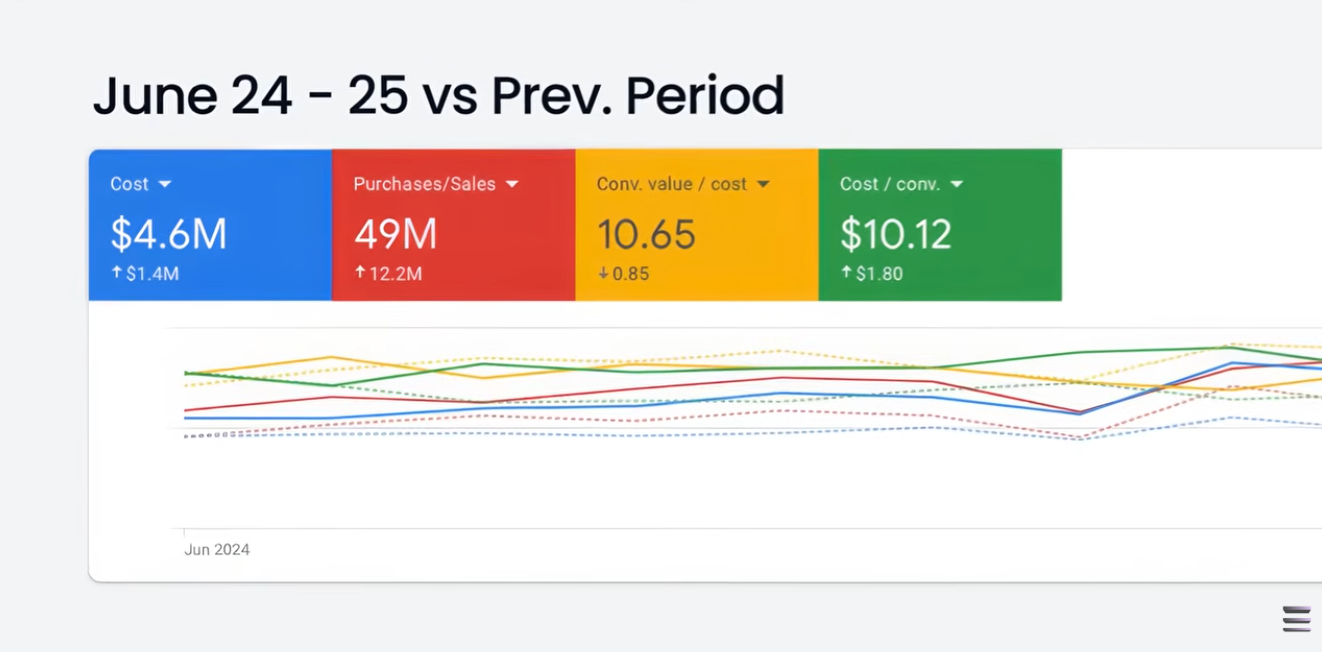
We saw this play out on an account we took over. Overall, the account was sitting on a 7.52 ROAS, and one specific campaign was running at 6.28. Across the board, that looks great. But once you open Insights and Reports and pull the search terms report, you see what's actually happening at a search term level. It was almost entirely branded. Sort that report by cost, and the branded terms are the ones carrying huge ROAS numbers, skewing the blended figure for the entire campaign.
“A blended ROAS number tells you nothing about where the credit is actually coming from. Until you break a campaign's search terms report down by branded versus non-branded spend, you don't know if you're acquiring new customers or just getting billed for people who were going to buy anyway.”
What Inflated ROAS Actually Costs You
That blended number isn't just misleading, it's also expensive. Three things happen when branded traffic hides inside a prospecting campaign:
- It inflates your prospecting metrics. You end up thinking the account is doing great with new customer acquisition when it isn't. You're paying premium PMax rates for people who were already going to buy, often at three to ten times the cost per click you should be paying for branded traffic.
- It drives branded CPCs up. When branded searches get picked up by campaigns built for prospecting, Google applies the aggressive bidding strategy meant for non-branded traffic to a cheap branded click. We've seen branded CPCs sitting at $6 plus, sometimes $10, when they should be sitting at $0.30 to $0.40.
- It prevents you from scaling. You can't see real prospecting performance data, so every decision you make about budget and bids is based on numbers that don't reflect what's actually driving new customers to the business.
The Prospecting Stack: How We Structure Google Ads for New Customer Growth
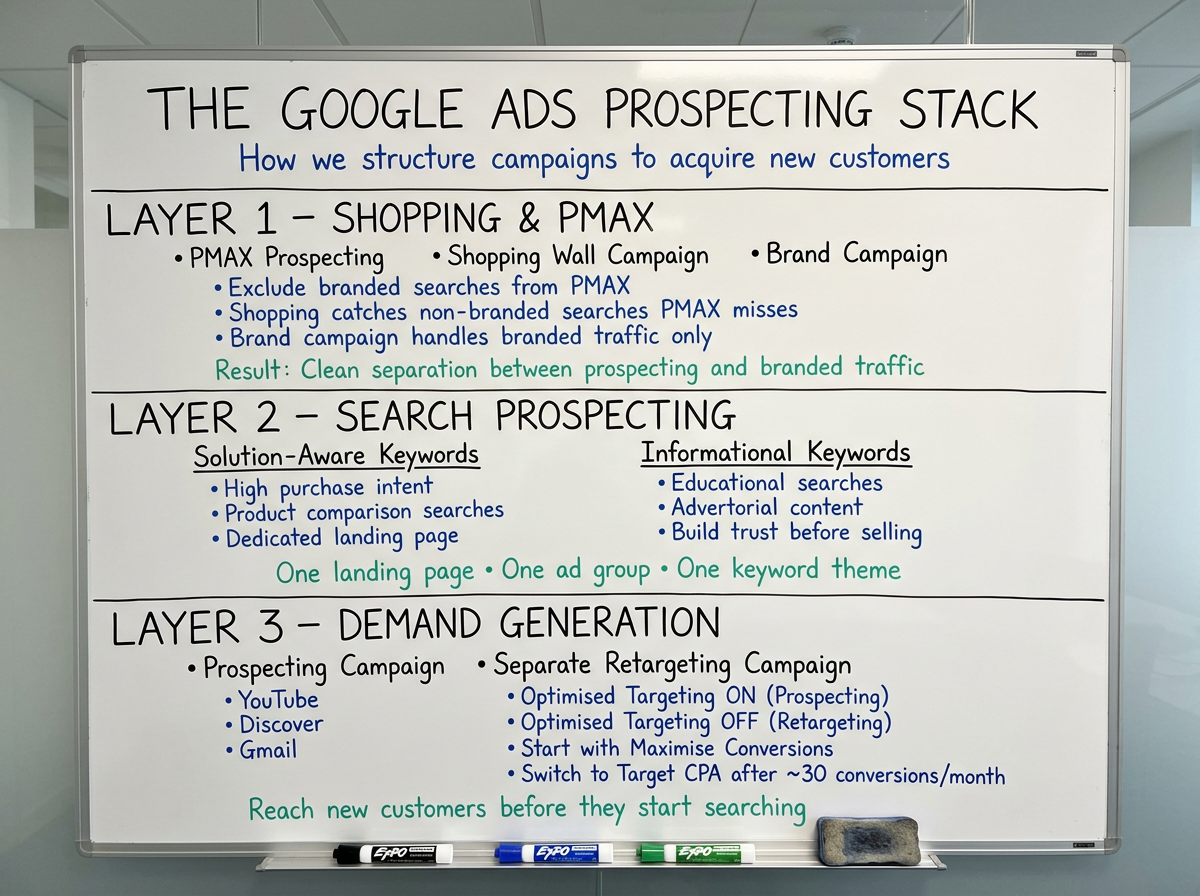
Once we identified that problem on the account above, we rebuilt the structure around what we call the Prospecting Stack. It's the framework we use for every client: multiple campaign types working together to find new customers, organised in a specific structure. Each layer reaches people in a different mindset, at a different point in the buying journey. Together, they create a stack where new customers can find you no matter how they're searching or browsing.
Layer 1: Shopping and PMax Prospecting
If you sell physical products online, Shopping will likely drive most of your Google Ads revenue. Performance Max builds on the same product feed from Google Merchant Center, but serves ads across Google's entire inventory, from Search to YouTube and Maps. That's why keeping your Merchant Center feed in good shape is so important.
The problem is that PMax, left on its default settings, takes the path of least resistance. It prioritises the cheapest conversions, which are often branded searches. Without proper brand exclusions, it ends up taking credit for those conversions instead of finding new customers.
PMax also doesn't capture every non-branded search. That's why we place a standard Shopping "wall" campaign between PMax and the brand campaign:
- PMax prospecting handles most non-branded traffic.
- The Shopping wall campaign catches eligible non-branded searches PMax doesn't pick up.
- The brand campaign only serves genuine branded searches.
Because both PMax and the wall campaign exclude brand terms, non-branded traffic never spills into your branded campaigns.
Layer 2: Search Prospecting and the Two Keyword Levels Most Brands Miss
Shopping captures people searching for products. Search prospecting reaches people earlier in the buying journey – when they're comparing options or researching a problem your product solves. For prospecting, we focus on two types of keywords.
Solution-aware keywords come from people who know what they need but haven't chosen a brand yet. Searches like "best tasting protein powder" or "collagen supplements for skin" have strong purchase intent and are often some of the highest-converting non-branded keywords.
Informational keywords target people who are still researching. Queries like "benefits of creatine" or "do grounding sheets actually work" usually have much lower CPCs because most competitors ignore them. While these users aren't ready to buy immediately, they're often open to the right educational content.
That's where comparison pages and advertorial-style landing pages come in. Instead of sending someone straight to a product page, send them to content that answers their question or compares the available options. We've seen this approach reduce CPCs by almost three times while improving conversion rates because it builds trust before asking for the sale.
The structure is simple: one landing page, one ad group, one keyword theme. Solution-aware keywords, informational content, and comparison pages should each have their own dedicated campaigns or ad groups. And just like Shopping, every prospecting campaign should exclude branded keywords using a shared negative keyword list.
Layer 3: Demand Generation: the Most Underused Prospecting Channel
Unlike Shopping and Search, Demand Generation reaches people before they actively start searching. It serves ads across YouTube, Discover and Gmail, making it one of the strongest Google Ads channels for finding new customers.
If you're already seeing good results from Meta, Demand Gen is the closest Google equivalent. The mindset is the same: people are scrolling content, not searching for products, so your ads should educate or spark curiosity rather than push an immediate sale. We typically send this traffic to advertorial-style landing pages instead of standard product pages.
One campaign we launched scaled from $0 to $500/day in just 30 days and became the second-best prospecting campaign by ROAS in an account with 22 active campaigns.
A few setup principles matter:
- Separate prospecting and retargeting into different Demand Gen campaigns.
- Leave Optimised Targeting on for prospecting, but turn it off for retargeting.
- Your budget should be at least twice your expected CPA. Start with Maximise Conversions, then move to Target CPA once the campaign has around 30 conversions per month.
- Test both image and video assets instead of assuming video will perform better.
What Order Should You Launch These Campaigns In?
Start with Shopping and PMax prospecting, using proper brand exclusions. That's the foundation, and it's where most eCommerce brands generate the majority of their revenue. Once you have enough conversion data to identify which landing pages perform best, add Search prospecting with solution-aware keywords, then expand into informational keywords and advertorial landing pages. From there, layer in Demand Gen.
There's no universal budget split between these campaign types. Some brands see stronger results from YouTube because they already have high-quality video assets, while others get better performance from Discover with static creatives. Build the foundation first, then expand based on the assets and data you have.
“In Search campaigns, keywords tell Google when to show your ads. In Shopping campaigns, your product titles perform the same role. That's why keyword research should shape both your Search campaigns and your Merchant Centre feed.”
How Keyword Strategy Powers Your Google Ads Prospecting
Keywords don't just determine which Search ads appear. They also influence how Google matches your Shopping products to search queries through your Merchant Center feed.
That means keyword research should shape both your Search campaigns and your product titles. Use your search terms reports to identify the queries that actually convert, then incorporate those keywords into your feed. Put the primary keyword first, as Google typically displays only around the first 70 characters of a product title. For prospecting campaigns, lead with the search term rather than your brand name.
Product duplication takes this a step further. Instead of relying on a single product listing, create multiple versions of the same product with different keyword-focused titles. A creatine supplement, for example, could target searches such as "creatine monohydrate," "creatine for muscle growth," or "creatine for women." Each listing gives Google another opportunity to match your product to a relevant search.
We used this approach, together with informational keyword targeting and branded campaign optimisation, on a supplement brand's hero product. Over 12 months, it contributed to $12.2 million in additional revenue and a 151% increase in new customer acquisition.
How to Do Keyword Research for New Customer Campaigns
Start by identifying solution-aware keywords (e.g. "protein powder for weight loss") alongside informational queries that people search before they're ready to buy. These keywords should shape both your Search campaigns and your Shopping feed.
Structure each ad group around a single landing page and keyword theme, then review your search terms reports regularly. Add high-performing queries as keywords in Search and incorporate them into your product titles for Shopping. Remove irrelevant searches with negative keywords to keep prospecting focused.
What Audience Targeting Actually Does in Prospecting Campaigns
Keywords tell Google what people are searching for. Audiences help Google understand who those people are. How they're used depends on the campaign type: in Performance Max, audiences act as signals that guide Google's algorithm, while in Demand Gen they behave much more like traditional targeting, especially with Optimised Targeting turned off.
The main audience types to use are:
- Custom Segments – audiences you build from URLs your ideal customers visit (competitor sites, review sites, publications in your category) and search terms they use. This is generally the most powerful audience layer for prospecting.
- In-market Audiences – people Google has identified as actively researching products in your category.
- Affinity Audiences – broader groups based on long-term interests and lifestyle, useful for expanding reach at the top of the funnel.
- Customer Match – your existing customer list, which helps Google understand your ideal customers and lets you exclude them from prospecting campaigns.
Don't overlook search themes in Performance Max. They're keyword-like signals that help Google understand which searches are most relevant to your products and work alongside audience signals to improve targeting.
Two rules apply to every prospecting account:
- Exclude existing customers and remarketing audiences from prospecting campaigns.
- Turn Optimised Targeting off for remarketing campaigns, otherwise Google will expand beyond your website visitors.
Final Takeaway: New Customer Growth Is a Structure Problem, Not a Budget Problem
Many Google Ads accounts aren't struggling because they don't spend enough. They're struggling because they're spending in the wrong places. When branded traffic, remarketing and prospecting are all mixed together, it's almost impossible to tell what's actually driving growth.
Real new customer acquisition starts with the right structure. Separate prospecting from brand, build campaigns around search intent, and give each channel a clear role in the customer journey. Once you can see where new customers are really coming from, you can scale with confidence instead of guesswork.

Ready To Start Scaling Today?
Scaling Your Favorite eCommerce Brands To The Highest Levels Through Google & YouTube Ads.

.svg)
Get Smarter About How To Scale Your Brand...
Discover Insider Knowledge On How We Scale Brands From 7 Figures All The Way Up To 8-9 Figures With Google Ads.
.svg)
.svg)
"The best Google ads agency there is. You only need to look at the quality of clients and the reviews to understand Jackson and his team are the real deal."

"One of the best in the agency space, great service and exceptional results. Since signing on with Jackson he has become one of our greatest assets when scaling."

"Top tier team & service delivery. Jackson is relentless when it comes to fulfilment & client needs. His attention to detail during the onboarding process ensured exponential results for my coaching business. If you're looking to elevate your ad results & learn a tone of new options/skills that can be implemented to drive more sales to your business then I'd strongly recommend Echelonn."

"From the very first conversation with Jackson and his team, it was clear that we had found a Google Ads agency that prioritises results above all else. Their collaboration between data-driven experts and a skilled copywriter creates a dynamic duo for Google advertising success..."

"Been working with them for 9 months and it's been a great experience. Jackson and his team know what they are doing and always goes above and beyond. If you're looking for a reliable Google ads agency this is the one."

"The best Google ads agency there is. You only need to look at the quality of clients and the reviews to understand Jackson and his team are the real deal."
"One of the best in the agency space, great service and exceptional results. Since signing on with Jackson he has become one of our greatest assets when scaling."
"Top tier team & service delivery. Jackson is relentless when it comes to fulfilment & client needs. His attention to detail during the onboarding process ensured exponential results for my coaching business. If you're looking to elevate your ad results & learn a tone of new options/skills that can be implemented to drive more sales to your business then I'd strongly recommend Echelonn."
"From the very first conversation with Jackson and his team, it was clear that we had found a Google Ads agency that prioritises results above all else. Their collaboration between data-driven experts and a skilled copywriter creates a dynamic duo for Google advertising success..."
"Been working with them for 9 months and it's been a great experience. Jackson and his team know what they are doing and always goes above and beyond. If you're looking for a reliable Google ads agency this is the one."
More Articles Like This.
Find answers to common queries about our services and how we can help you.
.svg)
Performance Max Audience Signals Explained
Google Ads Optimization Score: Should You Trust It?
What Is a Good CTR for Google Ads?
Why More Google Ads Spend Doesn't Always Mean More Revenue
How To Rank Your Google Shopping Ads Multiple Times
Why Your Google Ads Scale Breaks After $X Per Day
How to Tell if Your Google Ads Agency Is Underperforming
Why Your Performance Max Campaign Gets Clicks but No Sales
.png)
Why Your Google Ads Budget Isn't Spending (And How to Fix It)

The Right Way to Run Google Dynamic Search Ads
How to Get New Customers With Google Ads in 2026
Why Your Google Ads CPA Keeps Increasing and How to Reduce It
What Is a Good ROAS for eCommerce Businesses?
How to Set Up Google Ads Conversion Tracking the Right Way
How Much Does a Google Ads Agency Cost?
Why Your Google Ads Are Not Converting
.png)
Average CPC in Google Ads by Industry (And What It Means for Your Strategy)
Performance Max vs. Shopping Campaigns: Which One is Better?

Why Your Google Shopping Ads Get Impressions But No Clicks (Image Optimization Guide)
Why Your Google Ads Are Not Showing

YouTube Ads Targeting Framework That's Driven $10M+ for eCommerce Brands

What Professional Google Shopping Ads Management Looks Like
How Much Do Google Ads Cost in 2026?

Should Your Business Use Google Search Ads or Performance Max?

Performance Max Best Practices for Sustainable Growth
.png)
Google Shopping Ads Audience Targeting: What Actually Impacts Performance
.png)
How to Write Google Search Ads That Actually Convert
.png)
6 Google Shopping Feed Best Practices That Drive Better ROAS
%20(1).png)
How to Get Your Products Recommended by AI (ChatGPT, Google AI & More)
.png)
Common Google Ads Myths That Cost Businesses Money
.png)
7 Benefits of Google Shopping Ads for Your eCommerce Business
.png)
How to Switch Google Ads Agency Without Losing Performance or Data
.png)
Demand Capture vs Demand Generation: Where Google Ads Fits
.png)
How to Prepare Your Business for Working With a Google Ads Agency

How to Avoid Wasting Budget on the Wrong Searches With Google Ads Keyword Match Types
Google Ads Account Ownership: What Businesses Should Know Before Hiring an Agency
.png)
Landing Page Optimization Strategies That Increase Conversions
SEO and Google Ads: How Search Engine Optimization and Paid Search Work Together
Types of Remarketing in Google Ads: How Each One Works and When to Use It
Google Ads Keyword Research: How to Find Keywords That Actually Convert
.png)
What Is Google Performance Max and How Does It Work?
.png)
How Advertorials Support High-Intent Google Ads Funnels
%20(Canva%20Template).png)
How Audience Targeting Works in Google Search Ads (and When to Use It)

Google Ads for New Brands: What to Know Before Spending Your First Dollar
.png)
What Is a PPC Agency – and When It Makes Sense to Hire One
.png)
How to Improve Your Google Ads Conversion Rate

.png)
The Right Way to Link Shopify and Google Ads for Scalable Growth
Google Shopping Campaigns Setup Guide 2025
Confessions of a Google Ads Auditor: The Worst Mistakes We See Inside eCom Accounts
How to Spy on Competitor Google Ads: Complete 2025 Guide
%20(2).png)
7 Questions to Ask Before Hiring a Google Ads Consultant
How to Rank #1 on Google Ads: Complete Shopping & Search Guide 2025
.png)
Learning Google Ads in 2025: The Roadmap Nobody Talks About
%20(1).png)
What Makes a Google Ads Specialist Worth $10,000/Month?

Why Cheap Google Ads Consulting Costs You $180,000+ in Lost Revenue
.png)
Why 99% of Google Ads Experts Fail (& How to Find One That Won’t)
.png)
5 Google Product Feed Fixes for eCom Growth
.png)
Google Ads Campaign Structure: Why 95% of Brands Waste Budget on Mixed Traffic

In-House vs Agency Google Ads: Which Delivers Better ROI in 2025?
.png)
How to Scale Google Ads With a Small Budget | Setup and Optimization

Google Shopping Optimization: 11 Proven Tactics for Maximum ROAS
%20(3).png)
eCom Growth Strategy: How We Scaled a Supplement Brand From $1.9M to $8.6M With Google Ads
%20(4).png)
Google Merchant Center Fix: How to Improve Rankings With Accurate Shipping Times

CTR Is Misunderstood by 95% of the PPC Industry (What to Optimise for Instead)
.png)
Google Ads AI | Manual vs Automated Campaign Performance

Complete YouTube Ads Guide 2025 | 3 Formats, 5 Principles, Proven Results
%20(2).png)
eCom Growth Strategy With Google Ads in 2025
.png)
Google Marketing Live 2025: 11 Key Takeaways for Marketers
%20(1).png)
YouTube Advertising Strategy: How to Drive Results Across Every Format
Google Shopping Feed Optimisation: Tips for Better Results

How Long Does it Take for Google Ads to Work?

YouTube Ads Analytics 101: Key Metrics and How to Use Them

Search Ad Strategies to Maximize Sales with Google ads for eCommerce (2024)

2025 Google Shopping Ads: Ultimate Guide, Benchmarks, and Pricing Breakdown

Maximizing ROI with Advanced Google Shopping Bid Strategies and Automated Bidding