
.svg)
How to Write Google Search Ads That Actually Convert


You’ll find a lot of advice out there around writing Google Search ads focused on improving CTR. More compelling headlines, stronger calls to action, better use of keywords. This approach is not wrong – it’s the basis of what makes a good Google Search ad copy.
But high CTR doesn't necessarily mean high performance. Many accounts generate consistent traffic and still struggle to convert. The ads attract attention, but they don’t translate into revenue. This happens because Google Search doesn’t reward creativity in the same way other platforms do. It rewards alignment. Users arrive with a specific intent, and the system prioritises ads that match that intent clearly and directly.
Writing Google Search ads that actually convert is about being persuasive – but more importantly, it’s also about being more precise. This guide breaks down what drives performance in Google Ads copywriting – and where many strategies fall short.
Why Most Google Search Ads Fail to Convert
The issue with Google Search ads that don’t convert is usually not that they are poorly written, but that they are misaligned with what the user actually wants. At a surface level, performance often looks healthy. CTR is strong, CPC is stable, and traffic volume is consistent. But conversion rates remain low or stagnant. This creates a disconnect where the ad copy is often blamed for poor performance, even when it’s technically "well-written."
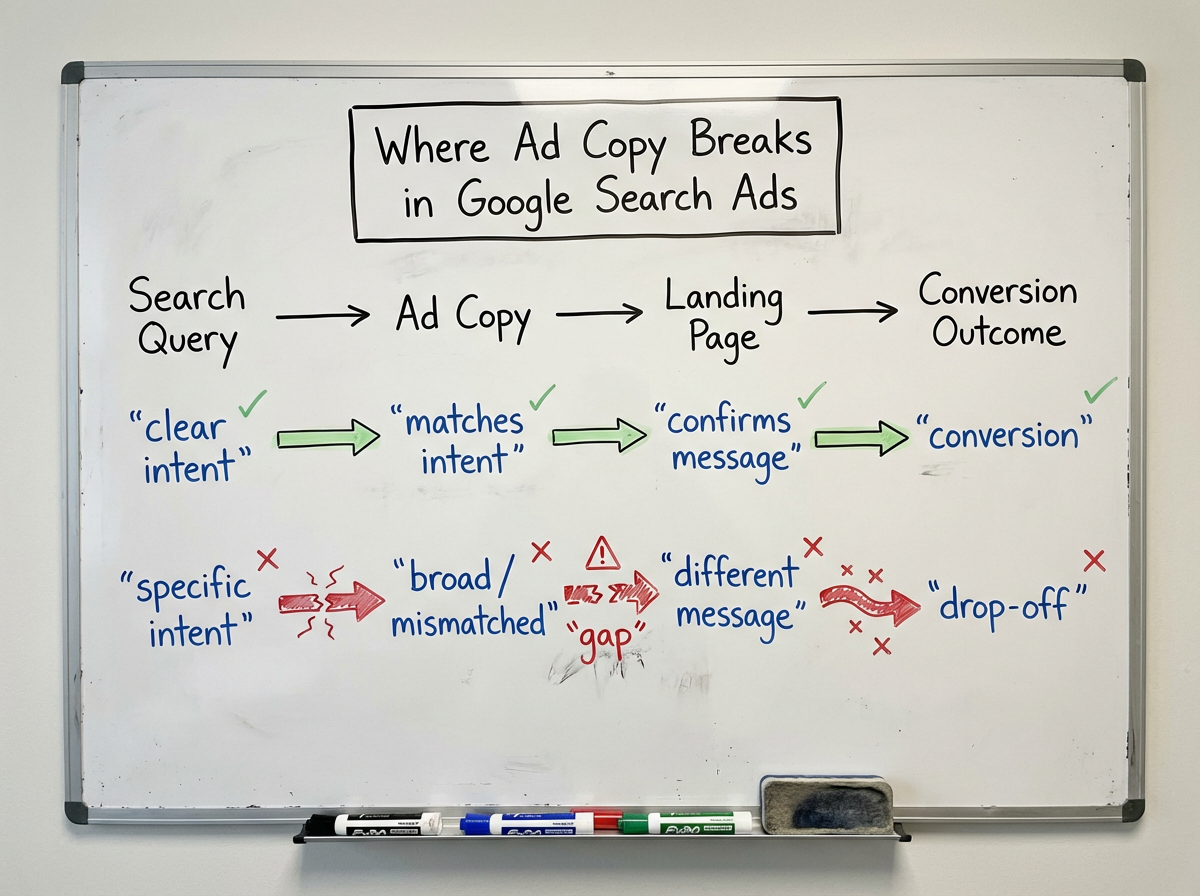
In reality, the problem usually sits in the gap between three elements: the search query, the ad copy, and the landing page. When a user searches, they are expressing a very specific need – this is even more visible with the rise of AI-driven search, where queries are becoming more conversational and nuanced. If the ad captures attention but introduces a slightly mismatched message, it creates immediate friction the moment the user hits the landing page. If the page doesn’t immediately reinforce the exact angle introduced in the ad, users hesitate and leave. From the system’s perspective, this results in weaker conversion signals, even if engagement metrics at the ad level look strong.
Another common issue is that Google Search ads are written to maximise clicks rather than to qualify them. Broad messaging attracts a wider audience, including users who are not ready to convert. Over time, this inflates traffic while diluting overall performance. Because of that, improving ad performance is rarely about making ads more compelling. Instead, it’s about reducing the gap between what the user expects and what they actually experience after clicking. Until that gap is addressed, even well-written ads will continue to underperform.
The Core Principle: Intent Alignment Over Creativity
Different types of search queries reflect different stages of decision-making. A user searching “what is creatine” is looking for information. A query like “best creatine for muscle gain” signals comparison. “Buy creatine monohydrate” indicates clear purchase intent. Treating these queries with the same messaging leads to a disconnect, even if the ad itself is persuasive and creative. This is why identifying high-intent keywords is the necessary first step before you even begin drafting your copy – you need to know exactly what the user wants before you can align with it.
This is where many Google Ads copywriting approaches break down. They focus on making ads more attention-grabbing, instead of making them more relevant to the intent behind the query. In practice, informational queries require clarity and context. Comparison queries require differentiation. Transactional queries require directness and confidence. The role of ad copy is to match the intent as precisely as possible.
That is also why tactics that work in other channels often underperform in Search. Creative hooks, curiosity-driven headlines, or overly broad messaging can increase clicks, but they introduce ambiguity. And in a system driven by intent, ambiguity reduces conversion efficiency. The most effective Google Search ads are the ones that feel like a natural continuation of the search itself.
“In high-performing Search ads, each element has a distinct job: headlines confirm relevance, descriptions remove friction, and assets provide the contextual depth needed to qualify the click before it happens.”
What Actually Drives Conversion in Google Search Ad Copy
Google Search ads offer limited space. This forces prioritisation. High-performing ad copy doesn’t try to say more – it removes ambiguity, highlights the most relevant value, and makes the next step obvious. Each component of the ad plays a specific role in this process.
Headlines: Capturing Intent, Not Just Keywords
Headlines should convey immediate relevance. Their primary role is not to attract attention, but to confirm to the user that the ad matches what they are searching for. This goes beyond inserting keywords. Effective headlines reflect the meaning behind the queries, not just the wording.
A user searching for “best noise cancelling headphones under $200” is not just looking for headphones – they are evaluating options within a specific constraint. Headlines that acknowledge that context will outperform generic, product-focused messaging.
Clarity consistently outperforms cleverness and creativity here. Google’s own guidance on writing Google ads reinforces this approach, emphasising the importance of being specific, direct, and closely aligned with what users are searching for. Overly creative phrasing, vague benefits, or abstract language introduce friction at the very first step. The best-performing Google Search ads have headlines that feel like a direct response to the query.
Descriptions: Reducing Friction and Building Trust
If headlines capture intent and act as the door openers, descriptions are there to remove friction and resolve hesitation. This is where Search ad copy addresses the questions that typically prevent users from converting: price, risk, credibility, and differentiation. Strong descriptions don’t just repeat the headline. They expand on it by reinforcing why the click is worth taking.
In Google Ads copywriting, this often includes “low-friction” elements such as guarantees, clear delivery information, return policies, or social proof. These signals reduce perceived risk and help the user move forward with more confidence. At this stage, persuasion is less about emotional appeal and more about removing uncertainty. The clearer the offer and the conditions around it, the easier it is for the user to commit to the next step. High-performing Google Search ads use descriptions to bridge the gap between the initial interest and the final conversion on the landing page.
Assets (Extensions): Expanding the Message Beyond Headline Limits
Assets add depth without sacrificing clarity. They allow advertisers to surface additional context directly in the search results – whether it’s product categories, pricing, promotions, or key benefits. This not only increases visibility, but also helps users evaluate the offer before they even click.
Well-structured assets are not optional – they act as a filtering mechanism. By providing more detail upfront, they can actively reduce low-intent clicks while improving the quality of traffic that does engage. In this sense, assets are a core part of how Google Search ads communicate relevance, reinforce value, and improve overall conversion efficiency. When Search ad copy is supported by the right assets – like sitelinks that reflect specific intent or callouts that highlight trust signals – it creates a more authoritative presence that naturally leads to higher-quality conversions.
Strategic Friction: Pre-Qualifying Clicks vs. Maximising Them
Broad, non-specific messaging tends to increase CTR by appealing to a wider audience. But that same approach often attracts users who are not yet ready to convert. Over time, this inflates traffic while lowering overall efficiency.
High-performing ad copy does the opposite. It introduces a level of strategic friction – not by making the ad hard to understand, but by making the offer more specific. Contrary to one of the most common Google Ads myths, a higher CTR isn't always the goal if it leads to unqualified traffic. Pricing cues, clear product positioning, or explicit qualifiers help filter out low-intent users before they click. While this may lead to fewer total clicks, it results in significantly higher-quality traffic. In a system driven by conversion signals, this trade-off is essential. By pre-qualifying the user through your Google Search ads, you provide the algorithm with cleaner data, which improves bidding predictability and performance over time.
Where Ad Copy Breaks (and Why It’s Often Not the Real Problem)
Ad copy is often blamed when campaigns don’t convert, but it is rarely the root cause. A strong CTR combined with low conversion rates typically points to issues outside the ad itself. These can include broken or inaccurate tracking, friction in the checkout process, or a weak value proposition that fails to compete in the market.
In these cases, rewriting the copy has little impact. The message may already be aligned with the intent, but the user experience after the click doesn’t support the conversion. Before making changes to the ads, it’s worth reviewing your overall conversion rate optimization strategy to identify whether the issue lies somewhere else. This includes validating conversion tracking, testing the full user journey, and evaluating whether the offer is strong enough to convert the traffic being generated.
Before adjusting the ads, it’s worth understanding where performance issues actually come from. In many cases, Google Search ads are only a small part of a much larger systemic problem. Optimising ad copy in isolation often leads to false conclusions about performance.
Key Takeaway: Clarity Over Complexity
Google Search ads are not just about copywriting – relevance and clarity play the most significant roles. The goal is not to create the most engaging or creative message, but to match intent as directly as possible and reduce uncertainty at every step. This requires precision in how queries are interpreted, how value is communicated, and how expectations are set before the click.
When this is done well, performance becomes more predictable because the ads are better aligned with how the system actually works. Clarity doesn’t just improve conversion rates; it improves the data feeding back into the account. This leads to more stable optimisation, more informed forecasting, and better long-term results.

Ready To Start Scaling Today?
Scaling Your Favorite eCommerce Brands To The Highest Levels Through Google & YouTube Ads.

.svg)
Get Smarter About How To Scale Your Brand...
Discover Insider Knowledge On How We Scale Brands From 7 Figures All The Way Up To 8-9 Figures With Google Ads.
.svg)
.svg)
"The best Google ads agency there is. You only need to look at the quality of clients and the reviews to understand Jackson and his team are the real deal."

"One of the best in the agency space, great service and exceptional results. Since signing on with Jackson he has become one of our greatest assets when scaling."

"Top tier team & service delivery. Jackson is relentless when it comes to fulfilment & client needs. His attention to detail during the onboarding process ensured exponential results for my coaching business. If you're looking to elevate your ad results & learn a tone of new options/skills that can be implemented to drive more sales to your business then I'd strongly recommend Echelonn."

"From the very first conversation with Jackson and his team, it was clear that we had found a Google Ads agency that prioritises results above all else. Their collaboration between data-driven experts and a skilled copywriter creates a dynamic duo for Google advertising success..."

"Been working with them for 9 months and it's been a great experience. Jackson and his team know what they are doing and always goes above and beyond. If you're looking for a reliable Google ads agency this is the one."

"The best Google ads agency there is. You only need to look at the quality of clients and the reviews to understand Jackson and his team are the real deal."
"One of the best in the agency space, great service and exceptional results. Since signing on with Jackson he has become one of our greatest assets when scaling."
"Top tier team & service delivery. Jackson is relentless when it comes to fulfilment & client needs. His attention to detail during the onboarding process ensured exponential results for my coaching business. If you're looking to elevate your ad results & learn a tone of new options/skills that can be implemented to drive more sales to your business then I'd strongly recommend Echelonn."
"From the very first conversation with Jackson and his team, it was clear that we had found a Google Ads agency that prioritises results above all else. Their collaboration between data-driven experts and a skilled copywriter creates a dynamic duo for Google advertising success..."
"Been working with them for 9 months and it's been a great experience. Jackson and his team know what they are doing and always goes above and beyond. If you're looking for a reliable Google ads agency this is the one."
More Articles Like This.
Find answers to common queries about our services and how we can help you.
.svg)
Google Ads Optimization Score: Should You Trust It?
What Is a Good CTR for Google Ads?
Why More Google Ads Spend Doesn't Always Mean More Revenue
How To Rank Your Google Shopping Ads Multiple Times
Why Your Google Ads Scale Breaks After $X Per Day
How to Tell if Your Google Ads Agency Is Underperforming
Why Your Performance Max Campaign Gets Clicks but No Sales
.png)
Why Your Google Ads Budget Isn't Spending (And How to Fix It)

The Right Way to Run Google Dynamic Search Ads
How to Get New Customers With Google Ads in 2026
Why Your Google Ads CPA Keeps Increasing and How to Reduce It
What Is a Good ROAS for eCommerce Businesses?
How to Set Up Google Ads Conversion Tracking the Right Way
How Much Does a Google Ads Agency Cost?
Why Your Google Ads Are Not Converting
.png)
Average CPC in Google Ads by Industry (And What It Means for Your Strategy)
Performance Max vs. Shopping Campaigns: Which One is Better?

Why Your Google Shopping Ads Get Impressions But No Clicks (Image Optimization Guide)
Why Your Google Ads Are Not Showing

YouTube Ads Targeting Framework That's Driven $10M+ for eCommerce Brands

What Professional Google Shopping Ads Management Looks Like
How Much Do Google Ads Cost in 2026?

Should Your Business Use Google Search Ads or Performance Max?

Performance Max Best Practices for Sustainable Growth
.png)
Google Shopping Ads Audience Targeting: What Actually Impacts Performance
.png)
How to Write Google Search Ads That Actually Convert
.png)
6 Google Shopping Feed Best Practices That Drive Better ROAS
%20(1).png)
How to Get Your Products Recommended by AI (ChatGPT, Google AI & More)
.png)
Common Google Ads Myths That Cost Businesses Money
.png)
7 Benefits of Google Shopping Ads for Your eCommerce Business
.png)
How to Switch Google Ads Agency Without Losing Performance or Data
.png)
Demand Capture vs Demand Generation: Where Google Ads Fits
.png)
How to Prepare Your Business for Working With a Google Ads Agency

How to Avoid Wasting Budget on the Wrong Searches With Google Ads Keyword Match Types
Google Ads Account Ownership: What Businesses Should Know Before Hiring an Agency
.png)
Landing Page Optimization Strategies That Increase Conversions
SEO and Google Ads: How Search Engine Optimization and Paid Search Work Together
Types of Remarketing in Google Ads: How Each One Works and When to Use It
Google Ads Keyword Research: How to Find Keywords That Actually Convert
.png)
What Is Google Performance Max and How Does It Work?
.png)
How Advertorials Support High-Intent Google Ads Funnels
%20(Canva%20Template).png)
How Audience Targeting Works in Google Search Ads (and When to Use It)

Google Ads for New Brands: What to Know Before Spending Your First Dollar
.png)
What Is a PPC Agency – and When It Makes Sense to Hire One
.png)
How to Improve Your Google Ads Conversion Rate

.png)
The Right Way to Link Shopify and Google Ads for Scalable Growth
Google Shopping Campaigns Setup Guide 2025
Confessions of a Google Ads Auditor: The Worst Mistakes We See Inside eCom Accounts
How to Spy on Competitor Google Ads: Complete 2025 Guide
%20(2).png)
7 Questions to Ask Before Hiring a Google Ads Consultant
How to Rank #1 on Google Ads: Complete Shopping & Search Guide 2025
.png)
Learning Google Ads in 2025: The Roadmap Nobody Talks About
%20(1).png)
What Makes a Google Ads Specialist Worth $10,000/Month?

Why Cheap Google Ads Consulting Costs You $180,000+ in Lost Revenue
.png)
Why 99% of Google Ads Experts Fail (& How to Find One That Won’t)
.png)
5 Google Product Feed Fixes for eCom Growth
.png)
Google Ads Campaign Structure: Why 95% of Brands Waste Budget on Mixed Traffic

In-House vs Agency Google Ads: Which Delivers Better ROI in 2025?
.png)
How to Scale Google Ads With a Small Budget | Setup and Optimization

Google Shopping Optimization: 11 Proven Tactics for Maximum ROAS
%20(3).png)
eCom Growth Strategy: How We Scaled a Supplement Brand From $1.9M to $8.6M With Google Ads
%20(4).png)
Google Merchant Center Fix: How to Improve Rankings With Accurate Shipping Times

CTR Is Misunderstood by 95% of the PPC Industry (What to Optimise for Instead)
.png)
Google Ads AI | Manual vs Automated Campaign Performance

Complete YouTube Ads Guide 2025 | 3 Formats, 5 Principles, Proven Results
%20(2).png)
eCom Growth Strategy With Google Ads in 2025
.png)
Google Marketing Live 2025: 11 Key Takeaways for Marketers
%20(1).png)
YouTube Advertising Strategy: How to Drive Results Across Every Format
Google Shopping Feed Optimisation: Tips for Better Results

How Long Does it Take for Google Ads to Work?

Search Ad Strategies to Maximize Sales with Google ads for eCommerce (2024)

2025 Google Shopping Ads: Ultimate Guide, Benchmarks, and Pricing Breakdown

Maximizing ROI with Advanced Google Shopping Bid Strategies and Automated Bidding