
.svg)
Types of Remarketing in Google Ads: How Each One Works and When to Use It


Remarketing is one of the most familiar concepts in Google Ads – but also one of the most misunderstood. Many advertisers tend to treat it as a fallback tactic once campaigns stop delivering, or as an easy way to squeeze more value out of traffic they’ve already paid for. This mindset is often why remarketing underperforms and fails to drive meaningful results.
The difference between effective and ineffective remarketing rarely comes down to the type itself, but to how well the audience, message, and timing align with where the user is in their decision journey. Different remarketing approaches serve very different roles across the funnel, and using the wrong one at the wrong time often leads to wasted spend rather than a meaningful business impact. That’s why the question advertisers should ask isn't whether to use remarketing in Google Ads, but which type makes sense in a given context.
What Is Google Ads Remarketing and How Does It Work?
Google Ads remarketing allows you to reach users who have already interacted with your business in some way – whether by visiting your website, viewing specific pages, engaging with your videos, or existing in your first-party data. Remarketing is a well-known tactic, but it’s not always treated as a system built around recognition and context.
You’re no longer speaking to a cold audience, but rather re-entering a conversation that has already started. This distinction matters, because not all prior interactions signal the same level of intent. A user who bounced from a blog article is different from one who viewed your pricing page – and both differ from an existing customer. Even though they all technically qualify for remarketing, they represent different levels of intent and require different approaches.
In practice, remarketing works best when it reinforces a decision the user is already moving toward. It tends to struggle when it tries to force progression before the user is ready – for example, pushing conversion-focused messaging to visitors who are still exploring. Understanding how Google Ads remarketing works is, then, about recognizing what the prior interaction means and choosing the right approach.
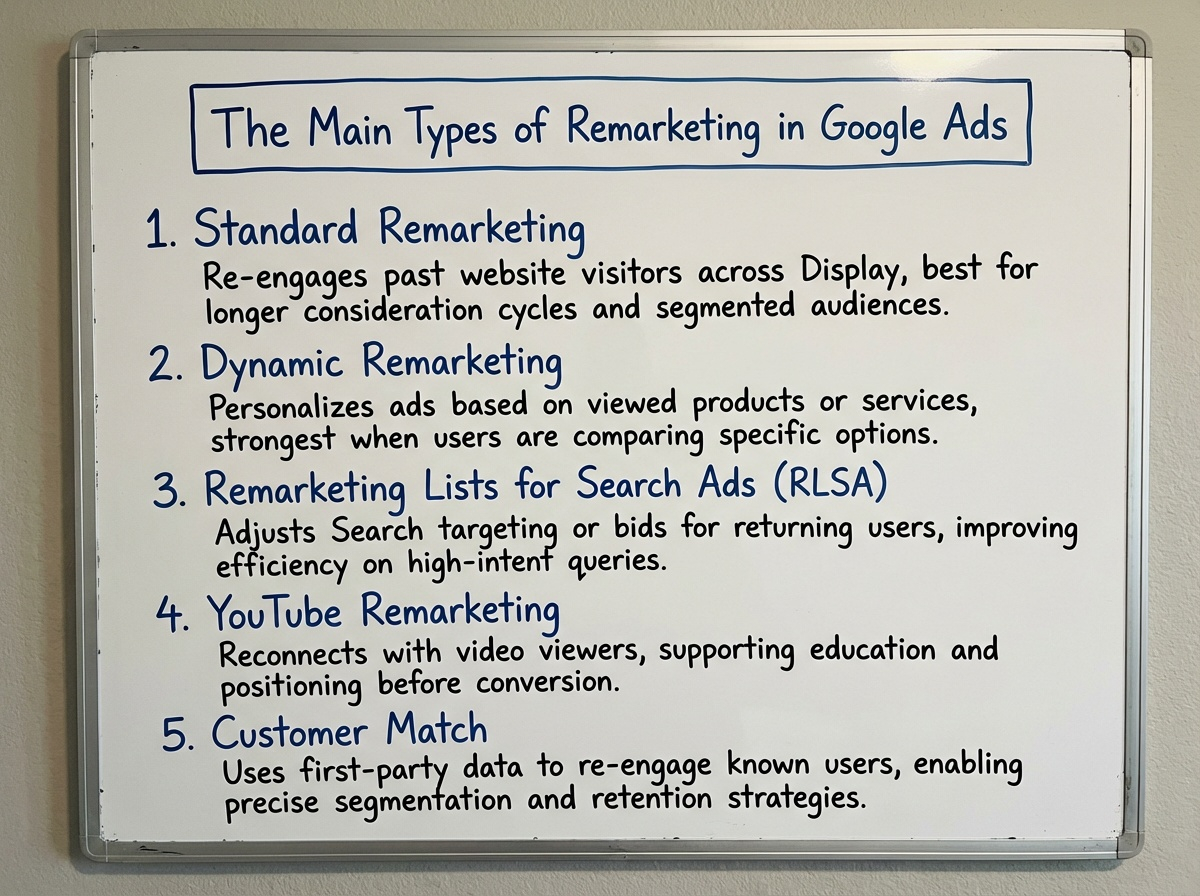
The Main Types of Remarketing in Google Ads
Standard Remarketing
Standard remarketing targets users who have previously visited your website and allows you to reach them again across the Google Display Network. This type of remarketing works best when users need more time between the first interaction and conversion. It helps to ensure that your brand stays visible to them while they continue to explore.
This is common in categories with longer consideration cycles, higher price points, or decisions that involve internal approval or comparison. Where it often underperforms is in accounts with limited traffic or overly broad audiences. Remarketing to all visitors tends to blur intent differences and inflate impression volume without meaningful impact. Standard remarketing is most effective when audiences are segmented by actions – for example, separating content readers from users who have engaged with product pages – rather than by visits alone.
Dynamic Remarketing
This type of remarketing builds on standard remarketing by personalizing ads based on what users have already viewed, such as a specific product or service. This approach tends to work best when the offer is clearly defined and comparable. Dynamic remarketing is most effective for eCommerce, as it helps encourage users to re-engage and come back to complete their purchase. It can also apply to service-based businesses with distinct packages, plans, or solutions.
At the same time, dynamic remarketing amplifies the existing structure – whether it’s strong or weak. If product feeds are incomplete, service pages are unclear, or differentiation is weak, personalization alone rarely fixes the problem. Dynamic remarketing works best when users are already evaluating concrete options and deciding what to choose next.
Remarketing Lists for Search Ads (RLSA)
RLSA allows you to adjust bids, targeting, or messaging in Search campaigns for users who have previously interacted with your website. It's particularly useful in competitive search environments, where returning users are often more likely to convert than first-time visitors. For example, users who have already explored your offer may later return through broader or competitive keywords – such as alternative searches, comparison queries, or non-branded commercial terms – as they move closer to a decision.
Remarketing Lists for Search Ads tend to work best when applied to high-intent search terms, where prior context meaningfully changes the likelihood of conversion. In accounts with limited conversion data or very small remarketing lists, its impact can be insignificant. On the other hand, when applied to the right search terms, it can improve efficiency by prioritizing users who already have context and understand the offer, without changing the underlying intent of the search itself.
YouTube Remarketing
YouTube remarketing targets users who have interacted with your videos or channel, allowing you to re-engage them through video or across other Google Ads placements. It’s most effective when video plays an important role in education or positioning. For products that require explanation, reassurance, or differentiation, YouTube remarketing can help bridge the gap between awareness and intent.
One critical technical detail that separates effective YouTube remarketing from wasted spend is the Optimized Targeting setting (also referred to as “Expansion”). If left enabled, Google may expand the audience beyond your original remarketing list, which can shift the campaign from pure remarketing into broader prospecting. A common best practice is to run separate campaigns – retargeting with Optimized Targeting off and prospecting with it on – each with its own audiences and budget.
Where YouTube remarketing often struggles is when it’s treated as a direct-response shortcut. Users who watched a short video are not automatically ready to convert. Without alignment between the original video content and the follow-up message, remarketing can feel disconnected rather than supportive.
Customer Match
This remarketing type in Google Ads uses first-party data, such as email lists or CRM records, to reach known users across Google’s inventory. It’s particularly valuable in businesses with existing customer relationships, repeat purchase cycles, or long sales processes. It allows for segmentation based on decision stage – for example existing customers versus prospects, or active users versus users whose engagement is declining.
Because Customer Match relies on first-party data, it’s essential that all data is collected and used in compliance with privacy regulations (such as GDPR or CCPA) and Google’s Customer Match policies.
The effectiveness of Customer Match depends heavily on data quality and segmentation. Uploading broad or unstructured lists often leads to diluted messaging and limited impact. When lists reflect meaningful business goals and data, Customer Match can support retention, reactivation, and more predictable scaling.
“The effectiveness of remarketing is rarely about the type itself. It depends on whether your traffic quality, segmentation, and intent signals are strong enough to support scaling.”
How to Choose the Right Remarketing Type for Your Google Ads
Choosing the right type of remarketing in Google Ads is primarily a business and data decision. Different remarketing approaches rely on different assumptions about user intent, traffic volume, decision timelines, and the strength of your offer.
If your sales cycle is short and intent is already high, such as in branded search, high-commercial keywords, or product-specific queries, RLSA often makes the most sense, while dynamic remarketing can reinforce product-level consideration in eCommerce environments. In these cases, the goal is to remove friction and reinforce a decision that is already forming.
If your consideration cycle is longer – for example, higher-ticket products like furniture, electronics, or luxury goods, or products where customers are comparing multiple options across brands – remarketing may need to support progression rather than push for conversion. Here, YouTube or standard remarketing can help maintain visibility while users compare options and work toward a decision, provided that Optimized Targeting is disabled to keep the campaign focused on actual remarketing audiences.
If you have strong first-party data, Customer Match can be a strategic option – particularly for upsell, cross-sell, or reactivation. In DTC brands with subscription or replenishment models, segmenting audiences by lifecycle stage (first-time buyers, active subscribers, declining engagement) often produces more predictable outcomes than relying solely on website behavior. Equally important, these customer lists serve as signals that improve algorithmic performance across the entire account.
If traffic volume is limited, more complex remarketing structures may not generate meaningful impact. In these situations, the most important steps are improving initial traffic quality and conversion clarity. Only once that’s in place can remarketing deliver meaningful value.
Account maturity is also a critical aspect when it comes to success with remarketing in Google Ads. Broad remarketing audiences combined with automated bidding tend to perform better when there is sufficient historical data. In newer or low-volume accounts, tighter segmentation and clearer intent signals typically provide better results.
The Role of Audience Exclusions
Excluding audiences is just as important as building them. Without clear exclusions, remarketing campaigns can waste budget on users who have already converted or on segments that rarely progress.
Thoughtful exclusion lists preserve intent and improve efficiency by ensuring ads are shown only to users who still have a realistic path toward conversion. Common exclusions include recent purchasers, users who reached a thank-you page, or segments with consistently low engagement.
Effective remarketing is not only about who you include, but also about who you intentionally leave out.
The Bottom Line: Remarketing as a System, Not a Tactic
Remarketing in Google Ads is often positioned as a performance booster – a way to increase efficiency or recover lost conversions. In reality, it’s more of an amplifier. If your traffic is poorly qualified, segmentation is unclear, or your value proposition is weak, remarketing tends to amplify those weaknesses.
It also works the other way around – when structured thoughtfully and strategically, remarketing can reinforce real buying signals. It can support users who are actively evaluating, reconnect with those who stopped mid-decision, and extend relationships with existing customers. The different types of remarketing in Google Ads reflect different assumptions about intent, timing, and data. Treating them as part of a coordinated system instead of isolated tactics is what turns remarketing from repetitive visibility into meaningful business impact.

Ready To Start Scaling Today?
Scaling Your Favorite eCommerce Brands To The Highest Levels Through Google & YouTube Ads.

.svg)
Get Smarter About How To Scale Your Brand...
Discover Insider Knowledge On How We Scale Brands From 7 Figures All The Way Up To 8-9 Figures With Google Ads.
.svg)
.svg)
"The best Google ads agency there is. You only need to look at the quality of clients and the reviews to understand Jackson and his team are the real deal."

"One of the best in the agency space, great service and exceptional results. Since signing on with Jackson he has become one of our greatest assets when scaling."

"Top tier team & service delivery. Jackson is relentless when it comes to fulfilment & client needs. His attention to detail during the onboarding process ensured exponential results for my coaching business. If you're looking to elevate your ad results & learn a tone of new options/skills that can be implemented to drive more sales to your business then I'd strongly recommend Echelonn."

"From the very first conversation with Jackson and his team, it was clear that we had found a Google Ads agency that prioritises results above all else. Their collaboration between data-driven experts and a skilled copywriter creates a dynamic duo for Google advertising success..."

"Been working with them for 9 months and it's been a great experience. Jackson and his team know what they are doing and always goes above and beyond. If you're looking for a reliable Google ads agency this is the one."

"The best Google ads agency there is. You only need to look at the quality of clients and the reviews to understand Jackson and his team are the real deal."
"One of the best in the agency space, great service and exceptional results. Since signing on with Jackson he has become one of our greatest assets when scaling."
"Top tier team & service delivery. Jackson is relentless when it comes to fulfilment & client needs. His attention to detail during the onboarding process ensured exponential results for my coaching business. If you're looking to elevate your ad results & learn a tone of new options/skills that can be implemented to drive more sales to your business then I'd strongly recommend Echelonn."
"From the very first conversation with Jackson and his team, it was clear that we had found a Google Ads agency that prioritises results above all else. Their collaboration between data-driven experts and a skilled copywriter creates a dynamic duo for Google advertising success..."
"Been working with them for 9 months and it's been a great experience. Jackson and his team know what they are doing and always goes above and beyond. If you're looking for a reliable Google ads agency this is the one."
More Articles Like This.
Find answers to common queries about our services and how we can help you.
.svg)
Performance Max Audience Signals Explained
Google Ads Optimization Score: Should You Trust It?
What Is a Good CTR for Google Ads?
Why More Google Ads Spend Doesn't Always Mean More Revenue
How To Rank Your Google Shopping Ads Multiple Times
Why Your Google Ads Scale Breaks After $X Per Day
How to Tell if Your Google Ads Agency Is Underperforming
Why Your Performance Max Campaign Gets Clicks but No Sales
.png)
Why Your Google Ads Budget Isn't Spending (And How to Fix It)

The Right Way to Run Google Dynamic Search Ads
How to Get New Customers With Google Ads in 2026
Why Your Google Ads CPA Keeps Increasing and How to Reduce It
What Is a Good ROAS for eCommerce Businesses?
How to Set Up Google Ads Conversion Tracking the Right Way
How Much Does a Google Ads Agency Cost?
Why Your Google Ads Are Not Converting
.png)
Average CPC in Google Ads by Industry (And What It Means for Your Strategy)
Performance Max vs. Shopping Campaigns: Which One is Better?

Why Your Google Shopping Ads Get Impressions But No Clicks (Image Optimization Guide)
Why Your Google Ads Are Not Showing

YouTube Ads Targeting Framework That's Driven $10M+ for eCommerce Brands

What Professional Google Shopping Ads Management Looks Like
How Much Do Google Ads Cost in 2026?

Should Your Business Use Google Search Ads or Performance Max?

Performance Max Best Practices for Sustainable Growth
.png)
Google Shopping Ads Audience Targeting: What Actually Impacts Performance
.png)
How to Write Google Search Ads That Actually Convert
.png)
6 Google Shopping Feed Best Practices That Drive Better ROAS
%20(1).png)
How to Get Your Products Recommended by AI (ChatGPT, Google AI & More)
.png)
Common Google Ads Myths That Cost Businesses Money
.png)
7 Benefits of Google Shopping Ads for Your eCommerce Business
.png)
How to Switch Google Ads Agency Without Losing Performance or Data
.png)
Demand Capture vs Demand Generation: Where Google Ads Fits
.png)
How to Prepare Your Business for Working With a Google Ads Agency

How to Avoid Wasting Budget on the Wrong Searches With Google Ads Keyword Match Types
Google Ads Account Ownership: What Businesses Should Know Before Hiring an Agency
.png)
Landing Page Optimization Strategies That Increase Conversions
SEO and Google Ads: How Search Engine Optimization and Paid Search Work Together
Types of Remarketing in Google Ads: How Each One Works and When to Use It
Google Ads Keyword Research: How to Find Keywords That Actually Convert
.png)
What Is Google Performance Max and How Does It Work?
.png)
How Advertorials Support High-Intent Google Ads Funnels
%20(Canva%20Template).png)
How Audience Targeting Works in Google Search Ads (and When to Use It)

Google Ads for New Brands: What to Know Before Spending Your First Dollar
.png)
What Is a PPC Agency – and When It Makes Sense to Hire One
.png)
How to Improve Your Google Ads Conversion Rate

.png)
The Right Way to Link Shopify and Google Ads for Scalable Growth
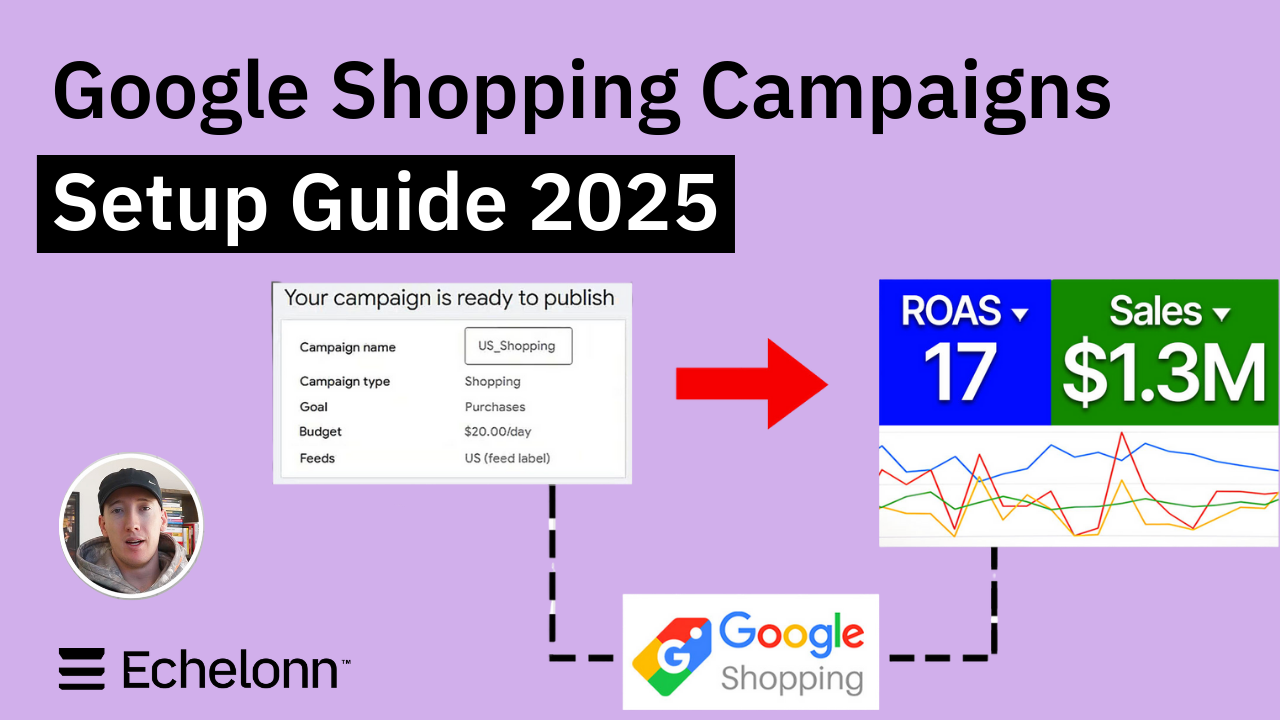
Google Shopping Campaigns Setup Guide 2025
Confessions of a Google Ads Auditor: The Worst Mistakes We See Inside eCom Accounts

How to Spy on Competitor Google Ads: Complete 2025 Guide
%20(2).png)
7 Questions to Ask Before Hiring a Google Ads Consultant
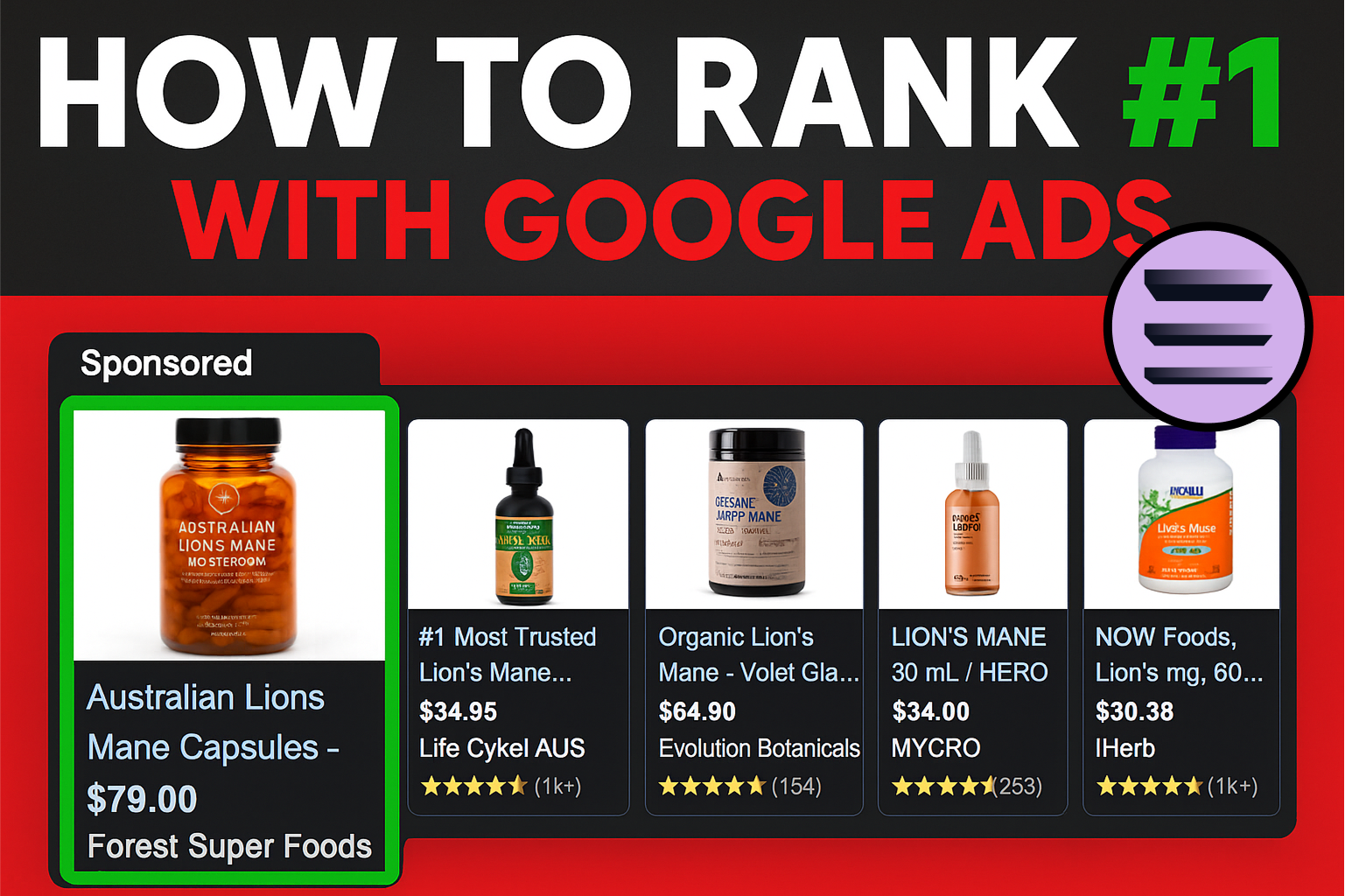
How to Rank #1 on Google Ads: Complete Shopping & Search Guide 2025
.png)
Learning Google Ads in 2025: The Roadmap Nobody Talks About
%20(1).png)
What Makes a Google Ads Specialist Worth $10,000/Month?

Why Cheap Google Ads Consulting Costs You $180,000+ in Lost Revenue
.png)
Why 99% of Google Ads Experts Fail (& How to Find One That Won’t)
.png)
5 Google Product Feed Fixes for eCom Growth
.png)
Google Ads Campaign Structure: Why 95% of Brands Waste Budget on Mixed Traffic

In-House vs Agency Google Ads: Which Delivers Better ROI in 2025?
.png)
How to Scale Google Ads With a Small Budget | Setup and Optimization

Google Shopping Optimization: 11 Proven Tactics for Maximum ROAS
%20(3).png)
eCom Growth Strategy: How We Scaled a Supplement Brand From $1.9M to $8.6M With Google Ads
%20(4).png)
Google Merchant Center Fix: How to Improve Rankings With Accurate Shipping Times

CTR Is Misunderstood by 95% of the PPC Industry (What to Optimise for Instead)
.png)
Google Ads AI | Manual vs Automated Campaign Performance

Complete YouTube Ads Guide 2025 | 3 Formats, 5 Principles, Proven Results
%20(2).png)
eCom Growth Strategy With Google Ads in 2025
.png)
Google Marketing Live 2025: 11 Key Takeaways for Marketers
%20(1).png)
YouTube Advertising Strategy: How to Drive Results Across Every Format
Google Shopping Feed Optimisation: Tips for Better Results

How Long Does it Take for Google Ads to Work?

YouTube Ads Analytics 101: Key Metrics and How to Use Them

Search Ad Strategies to Maximize Sales with Google ads for eCommerce (2024)

2025 Google Shopping Ads: Ultimate Guide, Benchmarks, and Pricing Breakdown

Maximizing ROI with Advanced Google Shopping Bid Strategies and Automated Bidding