
.svg)
.svg)




CONTEXT
Casa & Beyond is a large-scale home & lifestyle eCommerce brand managing over 12,000 SKUs across a broad range of categories, including homeware, furniture, and interior accessories.
The brand generates over $10M+ in annual revenue, with strong traction across its core markets, particularly Australia and the United States. Over the past 12 months, Casa & Beyond has generated approximately $14M AUD in Australia and $4M+ USD in the US, reflecting both scale and international growth potential
Operating on a pure direct-to-consumer (DTC) model, the business relies heavily on paid acquisition as a key driver of growth, with Google Ads playing a central role in its revenue generation strategy
Casa & Beyond runs a highly dynamic product catalog, continuously testing, launching, and scaling products based on performance data and customer demand. This ability to rapidly iterate and double down on winning products is a core part of their growth engine
As the brand expands across multiple markets, including Australia, the US, and emerging regions such as Canada, the UK, and New Zealand, maintaining consistency in performance while adapting to local market dynamics becomes a key factor in scaling efficiently
DIAGNOSIS
When we audited the account, we identified 3 structural issues that were limiting performance and creating significant waste:
1. Severe product-level waste - Over $100,000 per month was being spent, with a large portion of the budget allocated to products generating little to no revenue. This led to significant inefficiencies and limited the account’s overall profitability.
2. Unstructured product feed - The product catalog (12,000+ SKUs) lacked proper segmentation, which prevented effective budget allocation and scalable optimization:
- No clear product_type structure to organize the catalog
- Custom labels were not implemented, limiting performance-based segmentation
- Best-selling products were not prioritized, reducing their visibility and scaling potential
3. Brand and non-brand traffic mixed - Branded and non-branded traffic were not properly separated, leading to inaccurate performance insights which inflated reported ROAS and reduced the true incrementality of the account
APPROACH
We structured the account transformation in two layers:
- A foundational rebuild over the first 8 weeks
- A scalable growth roadmap focused on international expansion and channel diversification
Phase 1: Foundation & Control (Weeks 0–4)
The first phase focused on regaining control over the account by addressing the most critical structural and data-related issues. At the time of takeover, performance signals were unreliable due to conversion duplication and missing remarketing parameters, which directly impacted the accuracy of optimization decisions. We prioritized fixing these tracking issues to ensure that all future decisions would be based on clean and trustworthy data.
In parallel, we began reducing immediate inefficiencies across the account. A significant portion of spend was being allocated to low-performing products and non-converting queries, so we initiated a cleanup process by excluding unprofitable SKUs and high-cost, low-return search terms. We also removed product overlap across campaigns, which had previously created internal competition and diluted budget efficiency.
At the same time, we addressed key issues within Google Merchant Center, including missing product ratings, inconsistent shipping settings, and inactive promotions. These elements, while often overlooked, had a direct impact on visibility, click-through rate, and overall competitiveness in Shopping results. This phase allowed us to stabilize performance, reduce wasted spend, and establish a reliable baseline for further optimization
Month 1 Results | Australia (1-31 Oct 2025)

Month 1 Results | United States

Phase 2: Consolidation & Feed Structuring (Weeks 1–4)
Once the account was stabilized, the focus shifted toward building a scalable and structured foundation centered around the product feed. With a catalog of over 12,000 SKUs, the lack of segmentation was a major limitation, preventing efficient budget allocation and meaningful optimization.
To address this, we migrated feed management to DataFeedWatch, enabling full control over product data and allowing us to implement a structured segmentation strategy. We introduced consistent product categorization using product types and custom labels, which made it possible to differentiate products based on performance, pricing, and strategic importance. This transformation turned the product feed into a core lever for performance rather than a passive input.
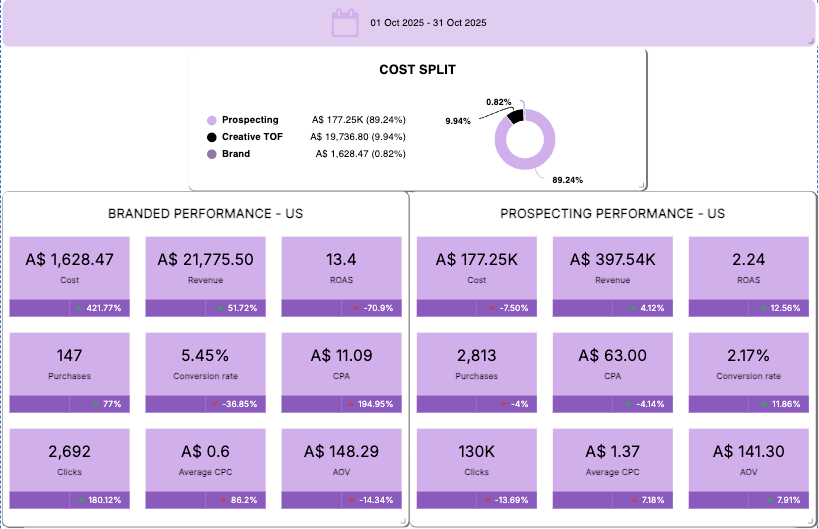
At the same time, we implemented a strict separation between branded and non-branded traffic. Previously, prospecting campaigns were capturing a portion of branded demand, which inflated performance metrics and reduced the account’s true incrementality. By isolating branded traffic into dedicated campaigns and progressively excluding it from prospecting, we were able to improve the accuracy of performance measurement and reallocate budget toward genuine acquisition.
This phase marked a critical transition from an unstructured account to a controlled and scalable system, where both product data and traffic sources were clearly segmented and aligned with business objectives
Month 1 Results after Brand/Non-Brand Split | Australia

Month 1 Results after Brand/Non-Brand Split | United States
Phase 3: Scalable Growth Framework (Weeks 4–8)
With a clean and structured foundation in place, we moved into building a scalable growth framework designed to unlock performance across the catalog. The strategy shifted toward a product-led approach, where individual products or product groups could be scaled independently based on their performance and demand.
We began by segmenting high-volume and high-potential products into dedicated campaigns, allowing for more precise control over budgets, bidding strategies, and search term quality. Product titles and attributes were continuously optimized based on search query data, while product duplication was introduced to test new angles, improve visibility on the SERP, and maximize exposure on high-intent queries.
In parallel, we expanded the campaign ecosystem to capture demand across different stages of the funnel. This included the launch of bottom-of-funnel Search campaigns targeting high-intent queries, Dynamic Search Ads to capture incremental demand, and YouTube campaigns supported by a structured creative testing framework. The objective was to create a diversified acquisition system that could generate both immediate conversions and long-term demand.
This phase enabled controlled scaling, where growth was driven by performance data and supported by a flexible structure capable of adapting to different products and market conditions
Month 2 Results | Australia

Month 2 Results | United States

Phase 4: International Expansion & Advanced Scaling (Week 8 Onwards)
Building on the scalable structure established in the previous phases, we developed a roadmap to expand into additional markets, including Canada, the United Kingdom, and New Zealand. Rather than simply replicating existing strategies, each market was approached as a distinct environment with its own consumer behavior, competitive landscape, and performance dynamics.
We introduced a structured expansion framework, starting with broad product coverage to gather initial data, followed by progressive segmentation based on local performance insights. This allowed us to identify winning products in each region and adapt our strategy accordingly, rather than assuming that top performers in one market would translate directly to another.
At the same time, we implemented advanced scaling mechanisms across the account. This included continuous Smart Bidding adjustments to balance scale and efficiency, structured creative testing cycles leveraging top-performing assets from other channels. The objective was to create a repeatable system where scaling could be executed consistently across markets without compromising profitability.
This final phase positioned the account for long-term growth, transforming it into a scalable and adaptable system capable of supporting both product expansion and international development.
RESULTS AFTER 1 MONTH OF COLLABORATION